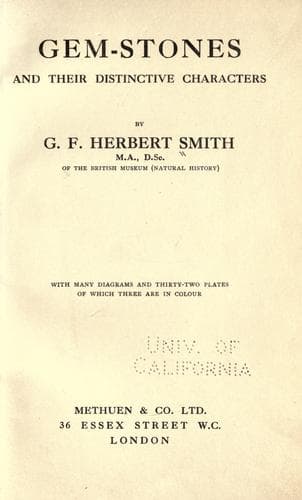
Gem-Stones and Their Distinctive CharactersSmith, George Frederick Herbert
Science
Gem-Stones and Their Distinctive Characters
Smith, George Frederick Herbert
Precious stones
Coral ranks far below pearl and meets with but limited appreciation.
It is common enough in warm seas, but the only kind which finds its
way into jewellery is the rose or red-coloured coral—the noble coral,
_Corallium nobile_ or _rubrum_. It consists of the axial skeleton of
the coral polyp, and is built up of hollow tubes fitting one within
the other. The composition is mainly calcium carbonate with a little
magnesium carbonate and a small amount of organic matter. The former
of the mineral substances is in the form of calcite, and the crystals
are arranged in fibrous form radiating at right angles to the axis of
the coral. The specific gravity varies from 2·6 to 2·7, being slightly
under that of calcite, and the hardness is somewhat greater, being
about 3¾ on Mohs’s scale.
The best red coral is found in the Mediterranean Sea off Algiers and
Tunis in Africa, and Sicily and the Calabrian Coast of Italy. The
industry of shaping and fashioning the coral is carried on almost
entirely in Italy. Coral is usually cut into beads, either round or
egg-shaped, and used for necklaces, rosaries, and bracelets. The best
quality fetches from 20s. to 30s. per carat.
AMBER
This fossil resin, yellow and brownish-yellow in tint, finds an
extensive use as the material for mouthpieces of pipes, cigar and
cigarette-holders, umbrella-handles, and so on, and is even locally
cut for jewellery, although its extreme softness, its hardness being
only 2½ on Mohs’s scale, quite unfits it for such a purpose. It is
only slightly denser than water, the specific gravity being about
1·10. Since the structure is amorphous the refraction is single, the
index being about 1·540. Amber, being a very bad conductor of heat, is
perceptibly warm to the touch. Its property of becoming electrified by
friction attracted early attention, and from the Greek name for it,
ἤλεκτρον, is derived our word electricity.
Amber is washed up by the sea off the coasts of Sicily and Prussia,
and of Norfolk and Suffolk in England. The finest examples, which are
picked up off the shore of Catania in Sicily, are distinguished by a
fine bluish fluorescence, resembling that seen in lubricating oil; such
pieces command good prices.
A recent resin, pale yellow in colour, known as kauri-gum, is found in
New Zealand, where it is highly valued.
TABLES
TABLE I
_Chemical Composition of Gem-Stones_
(_a_) ELEMENTS—
Diamond C
(_b_) OXIDES—
Corundum Al_{2}O_{3}
Quartz SiO_{2}
Chalcedony SiO_{2}
Opal SiO_{2}.nH_{2}O
(_c_) ALUMINATES—
Public-domain text, read in full here on John Shaqi.
Reviews
Reviews
No reviews yet
Be the first to share your thoughts on this work.
Elsewhere in the archive
Join the Discussion
Join the discussion
Sign in to leave a comment or review.
Sign InorCreate an account