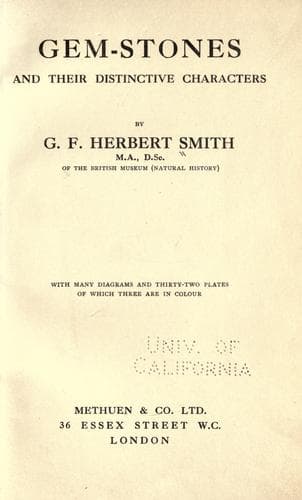
Gem-Stones and Their Distinctive CharactersSmith, George Frederick Herbert
Science
Gem-Stones and Their Distinctive Characters
Smith, George Frederick Herbert
Precious stones
Early attempts made to obtain the exquisite blue tint of the true
sapphire were frustrated by an unexpected difficulty. The colouring
matter, cobalt oxide, was not diffused evenly through the drop, but
was huddled together in splotches, and it was found necessary to add a
considerable amount of magnesia as a flux before a uniform distribution
of colour could be secured. It was then discovered that, despite the
colour, the stones had the physical characters, not of sapphire, but
of the species closely allied to it, namely, spinel, aluminate of
magnesium. By an unsurpassable effort of nomenclature these blue stones
were given the extraordinary name of ‘Hope sapphire,’ from fanciful
analogy with the famous blue diamond which was once the pride of the
Hope collection. A blue spinel is occasionally found in nature, but the
actual tint is somewhat different. These manufactured stones have the
disadvantage of turning purple in artificial light. By substituting
lime for magnesia as a flux, Paris, a pupil of Verneuil’s, produced
blue stones which were not affected to the same extent. The difficulty
was at length overcome at the close of 1909, when Verneuil, by
employing as tinctorial agents 0·5 per cent. of titanium oxide and 1·5
per cent. of magnetic iron oxide, succeeded in producing blue corundum;
it, however, had not quite the tint of sapphire. Stones subsequently
manufactured, which were better in colour, contained about 0·12 per
cent. of titanium oxide, but no iron at all.
By the addition to the alumina of a little nickel oxide and vanadium
oxide respectively, yellow and yellowish green corundums have been
obtained. The latter have in artificial light a distinctly reddish
hue, and have therefore been termed ‘scientific alexandrite’; of
course, quite incorrectly, since the true alexandrite is a variety of
chrysoberyl, aluminate of beryllium, a very different substance.
If no colouring matter at all be added and the alum be free from
potash, colourless stones or white sapphires are formed, which pass
under the name ‘scientific brilliant.’ It is scarcely necessary to
remark that they are quite distinct from the true brilliant, diamond.
The high prices commanded by emeralds, and the comparative success that
attended the reconstruction of ruby from fragments of natural stones,
suggested that equal success might follow from a similar process with
powdered beryl, chromic oxide being used as the colouring agent. The
resulting stones are, indeed, a fair imitation, being even provided
with flaws, but they are a beryl glass with lower specific gravity and
refractivity than the true beryl, and are wrongly termed ‘scientific
emerald.’ Moreover, recently most of the stones so named on the market
are merely green paste.
It is unfortunate that the real success which has been achieved in the
manufacture of ruby and sapphire should be obscured by the ill-founded
claims tacitly asserted in other cases.
Public-domain text, read in full here on John Shaqi.
Reviews
Reviews
No reviews yet
Be the first to share your thoughts on this work.
Elsewhere in the archive
Join the Discussion
Join the discussion
Sign in to leave a comment or review.
Sign InorCreate an account