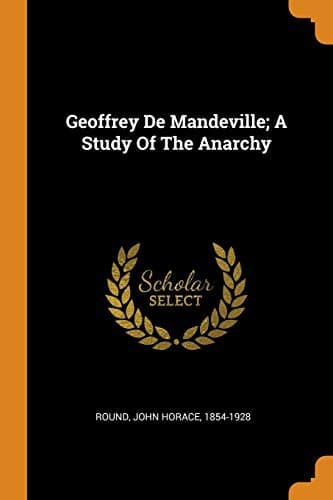
Geoffrey de Mandeville: A study of the AnarchyRound, John Horace
History
Geoffrey de Mandeville: A study of the Anarchy
Round, John Horace
Great Britain -- History -- Stephen, 1135-1154; Mandeville, Geoffrey de, earl of Essex, -1144
Edward of Southwark,
living 1125.
|
+---+---------+
| |
"Ingenolda," = Roger Edward = Godeleve. William,
living 1130. | "nepos de Cornhill,| living 1125.
| Huberti." living 1125.|
| |
| +----------+
| |
Gervase = Agnes
Fitz Roger de Cornhill,
(afterwards married
Gervase de before 1136.
Cornhill).
I say that this is a remarkable pedigree because, from the dates, Edward
of Southwark must have been born within a very few years of the
Conquest, and also because we can feel sure, in the case both of him and
of his son-in-law, that we are dealing with men of the old stock,
connected with the venerable gild of English "Cnihts." But it further
shows us how the elder of the two bestowed on his English son the name
of the Norman Conqueror, and how the Norman settlers intermarried with
the English stock.
Let us now return to the father of Gervase, Roger "nepos Huberti." Here,
again, there come to our help the records of the duchy of Lancaster.
Among them are two royal charters, the first of which grants to Roger
the manor of Chalk, in Kent,[900] while the second was consequent on his
death,[901] and should be read in connection with the above extracts
from the Pipe-Roll of 1130. This charter has a special interest from its
mention of the fact that Roger had gone "ad Jerosolima." We may infer
from this that he had died on pilgrimage.[902] As Gervase inherited from
his father so large an estate, Roger must have been, in his day, a man
of some consequence. It is, therefore, rather strange that his name does
not occur in the report on the muniments of St. Paul's, nor in any other
quarter to which I have been able to refer. Luckily, however, Stow has
preserved for us the gist of a document which he had seen, when he tells
us that on the grant of their soke, in 1125, by the Cnihtengild—
"The king sent also his sheriffs, to wit Aubrey de Vere and _Roger
nephew to Hubert_, which (upon his behalf) should invest this church
with the possessions thereof; which the said sheriffs accomplished,
coming upon the ground, Andrew Buchevite[903] and the forenamed
witnesses and others standing by."[904]
If we can trust to this passage, as I believe we certainly can, our
Roger was a sheriff of London in 1125. This makes it highly probable
that he was identical with the "Roger" named in a document addressed, a
few years earlier:—
"Hugoni de Bocheland, _Rogero_, Leofstano, Ordgaro, et omnibus aliis
baronibus Lundoniæ."[905]
Public-domain text, read in full here on John Shaqi.
Reviews
Reviews
No reviews yet
Be the first to share your thoughts on this work.
Elsewhere in the archive
Join the Discussion
Join the discussion
Sign in to leave a comment or review.
Sign InorCreate an account