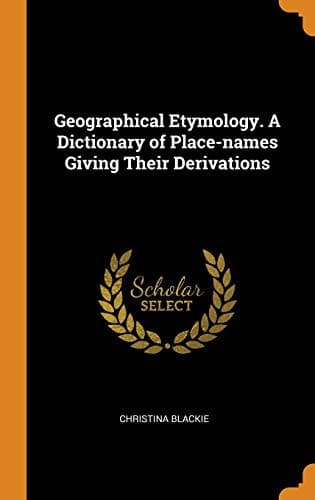
Geographical etymology: a dictionary of place-names giving their derivationsBlackie, Christina
History
Geographical etymology: a dictionary of place-names giving their derivations
Blackie, Christina
Names, Geographical
[Sidenote: KOPRI, KUPRI (Turc.),]
a bridge; _e.g._ Vezir-kopri (the vizier’s bridge); Keupri-bazaar (the
market-town at the bridge); Keupris (bridge town), in Turkey.
[Sidenote: KOS (Sclav.),]
a goat; _e.g._ Koselo (goat’s river); Koslin (goat town), in Pomerania.
[Sidenote: KOSCIOL (Sclav.),]
a Romish church; _e.g._ Kostel, Kosteletz (towns with a Romish church),
a Protestant church being called _Zbor_, and a Greek church _Zerkwa_.
[Sidenote: KRAL, KROL (Sclav.),]
a king; _e.g._ Kralik, Kralitz, Krolow, Kraliewa, Kralowitz (the king’s
town or fortress).
[Sidenote: KRASNA (Sclav.),]
beautiful; _e.g._ Krasnabrod (the beautiful ford); Krasnapol (the
beautiful city); Krasno-Ufimsk (the beautiful town of the R. Ufa);
Krasna and Krasne (the beautiful place).
[Sidenote: KRE (Sclav.),]
a coppice; _e.g._ Sakrau, Sakrow (behind the coppice).
[Sidenote: KREIS (Ger.),]
a circle; _e.g._ Saalkreis (the circle watered by the R. Saal);
Schwardswaldkreis (the circle of the Black Forest).
[Sidenote: KREM, KRIM (Sclav.),]
a stone building; _e.g._ The Kremlin (the stone fort of Moscow);
Kremmen, Kremenetz, Kremnitz, Kremmenaia, Kremenskaia, towns in Russia,
Poland, and Lusatia.
[Sidenote: KRONE, KRON (Teut. and Scand.),]
a crown; _e.g._ Kronstadt, Hung. _Brasso_ (crown city), in Hungary;
Cronstadt, in Russia, founded by Peter the Great; Königscrone (the
king’s crown); Carlscrone (Charles’s crown); Landscrone (the crown or
summit of the land), a mountain and town in Silesia--also with the same
meaning, Landscrona, in Sweden. _Kron_, however, as a prefix, comes
occasionally from _krahn_ (a crane), as in Kronwinkel (the crane’s
corner).
[Sidenote: KRUG (Ger.),]
a small inn; _e.g._ Dornkrug (the thorn inn); Krugmülle (the mill
at the inn).
L
[Sidenote: LAAG, LAGE (Ger.),
LOOG (Dutch),]
a site, a low-lying field; _e.g._ Brawenlage (brown field); Wittlage
(white field or wood field); Blumlage (flowery field); Mühlenloog (the
mill field or site); Dinkellage (wheat field). This word is also used
as an adjective, signifying _low_; _e.g._ Loogkirk (low church);
Loogheyde (low heath); Loogemeer (low lake); Laaland (low island).
[Sidenote: LAC (Fr.),
LACHE (Ger.),
LAGO (It., Span., and Port.),
LAGUNA,]
Public-domain text, read in full here on John Shaqi.
Reviews
Reviews
No reviews yet
Be the first to share your thoughts on this work.
Elsewhere in the archive
Join the Discussion
Join the discussion
Sign in to leave a comment or review.
Sign InorCreate an account