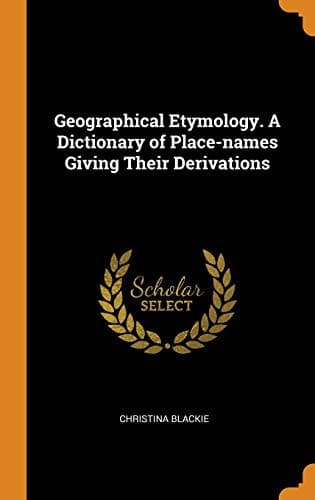
Geographical etymology: a dictionary of place-names giving their derivationsBlackie, Christina
History
Geographical etymology: a dictionary of place-names giving their derivations
Blackie, Christina
Names, Geographical
a round hill or a bald promontory, as an adjective signifying bald, and
often applied to hills and promontories, thus--the Mull or promontory
of Cantyre and Galloway; Meldrum, in Aberdeenshire, and Meeldrum,
in Ireland (the bald ridge); Melrose, _i.e._ _Maol-ros_ (the bald
headland), Old Melrose having been situated on a peninsula formed by
the Tweed; the Eildon Hills, near Melrose, corrupt. from _Moeldun_
(bald hill); the Island of Mull, one of the Hebrides; Mealfourvounie
(the hill of the cold moor), in Inverness-shire; Glassmeal (gray hill),
in Perth; Malvern (the bald hill of the alders, _gwernen_); Moel-y-don
(the hill of the waves), in Anglesea; Moel-Aelir (the frosty hill);
Muldonach (the hill of Donald), one of the Hebrides; Moel-Try-garn (the
ridge of the three cairns); Moel-Eilio (the mount of construction);
Moel-y-crio (the hill of shouting); Moel-ben-twrch (boar’s head
hill), in Wales; Moel-cwm-Cerwyn (the bald dingle of the cauldron);
Moelfre, corrupt. from _Moelbre_ (bald hill), in Wales. In Ireland this
word often takes the form of _moyle_, as in Kilmoyle (bald church);
Rathmoyle, Lismoyle, Dunmoyle (the bald or dilapidated fort); Mweelbane
(the white hill); Meelgarrow (rough hill); Meelshane (John’s bald
hill); Mweel-na-horna (the bald hill of the barley); Maulagh (abounding
in hillocks); Mullaghmeen (smooth hillock); Mulboy (yellow hillock),
etc.; Mullanagore and Mullanagower (the little summit of the goats). In
Wales: Moel-hebog (hawk hill); Moel-eryn (eagle hill), in Wales. The
Mool of Aswich and the Mool of Land, in Shetland.
[Sidenote: MOIN, MOINE (Gadhelic),
MON,]
a moss or bog. in Ireland: Mona-braher, _i.e._ _Moin-nam-brathar_
(the bog of the friars); Monalour (of the lepers); Moneen (the little
bog); Ballynamona (the town of the bog); Monard (high bog); Montiagh,
for _Mointeach_ (the boggy place); Monabrock (the badger’s moss);
Monroe (the red moss); _Mon_ is, however, sometimes used instead of
_monadh_ (a rising ground in a moor), as in Co. Monaghan, _Muineachan_
(abounding in little hills); which country, however, according to the
_Annals of the Four Masters_, was named from its chief town (the town
of monks). In Scotland: Moin, a moorland district in Sutherlandshire;
Monzie and Moonzie (the mossy land), in Fife and Perthshire; Montrose
(the boggy promontory); _Mon_, again for _monadh_, in Monimail (bald
hill), in Fife; Moncrieffe (the woody hill, _craobach_); Moness (the
hill of the cascade, _eas_).
[Sidenote: MÖNCH (Ger.),
MONEC (A.S.),
MONACH (Gadhelic),
MYNACH (Cym.-Cel.),]
Public-domain text, read in full here on John Shaqi.
Reviews
Reviews
No reviews yet
Be the first to share your thoughts on this work.
Elsewhere in the archive
Join the Discussion
Join the discussion
Sign in to leave a comment or review.
Sign InorCreate an account