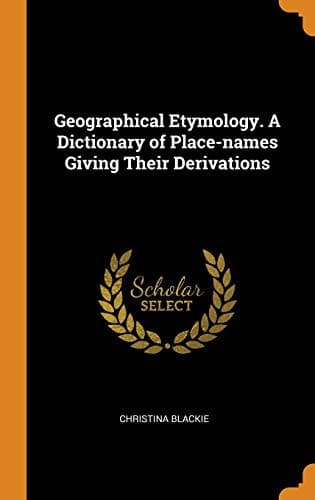
Geographical etymology: a dictionary of place-names giving their derivationsBlackie, Christina
History
Geographical etymology: a dictionary of place-names giving their derivations
Blackie, Christina
Names, Geographical
_Portus-cale_, both meaning the harbour; Porto-rico (rich port),
an island of the Antilles group; Porto-Santo (the holy port), in the
Madeira Isles; Porto-seguro (safe port); Porto-Vecchio (old port), in
Corsica; Porto-Alegre (the cheerful port), in Brazil; Porto-farina
(the port of wheat), in North Africa; Porto-ferrajo (fortified port),
in Tuscany, on the coast of the Island of Elba; Port-Vendres, Lat.
_Portus-Veneris_ (the port of Venus), in France; Le Treport, corrupt.
from the Lat. _Ulterior-Portus_, in Normandy, at the mouth of the
Bresle.
[Sidenote: PIC, PIKE (A.S.),
PIC and PUY (Fr.),
SPITZE (Ger.),]
a peak or promontory; _e.g._ the Pike o’ Stickle (the peak of the
high rock); the Peak, in Derbyshire; Pike’s Peak, in the Rocky
Mountains, named after General Pike; Spitz, in Austria, built around
a hill; Spitzbergen (the peaked mountains); Spithead (the head of
the promontory); Le Puy (the peak), a town situated on a high hill;
Puy-de-dome (the dome-shaped peak).
[Sidenote: PISCH (Sclav.),]
sand; _e.g._ Pesth, in Hungary (on a dry, sandy soil); but Buttman
suggests that the name may be derived from _paz_, Sclav. (a baking
place), as the German name for Buda, on the opposite side of the
Danube, is _Ofen_ (the oven); Peschkowitz, Peshen, Pisck, Pskov,
Peckska, in Russia and Bohemia. _Pies_, Sclav. (the dog), may, however,
be the root-word of some of these names.
PITT, PITTEN (Gadhelic),
a hole, a small hollow. This word, as a prefix, occurs very frequently
in Scotland, especially in Fife, in which county the most important
place is Pittenweem (the hollow of the cave, _uaimh_), the seat of an
ancient monastery, near which is the cave from which it was named;
Pitcairn (the hollow of the cairn), near Perth, in the neighbourhood
of which there are two large cairns of stones; Pitgarvie (the rough
hollow); Pitglas (the gray hollow); Pettinain (the hollow of the
river), a parish on the Clyde; Pittencrieff (the hollow of the
tree, _craobh_); Pitgober (of the goat); Pitnamoon (of the moss);
Pittendriech (the Druid’s hollow); Pitcaithly, probably the hollow
of the narrow valley, in Perthshire; Pittentaggart (the priest’s
portion)--as in ancient times, the word _pitte_ is understood to have
also meant a part or portion of land; and it has probably this meaning
in Pitlochrie, in Perthshire, anc. _Pittan-cleireach_ (the portion of
the clergy or church-land), as well as in Pittan-clerach, in Fife;
Pitmeddin, in Aberdeenshire, named after St. Meddane. Pittenbrae (the
hollow of the hill); Petty or Pettie, anc. _Petyn_ (the hollow of the
island), on Beauly Loch, Inverness; Pettycur (the hollow of the dell,
_coire_), in Fife.
[Sidenote: PLESSA (Fr.),
PLESSEICUM,]
meaning successively a hedge, an enclosed and cultivated place
surrounded by trees, an enclosed garden, a park, a mansion, or
country residence; _e.g._ Plessis, Le Plessin, Plessier, Le Plessial,
etc.--_v._ Cocheris’s _Noms de Lieu_.
[Sidenote: PLEU, or PLOE (Cym.-Cel.),]
Public-domain text, read in full here on John Shaqi.
Reviews
Reviews
No reviews yet
Be the first to share your thoughts on this work.
Elsewhere in the archive
Join the Discussion
Join the discussion
Sign in to leave a comment or review.
Sign InorCreate an account