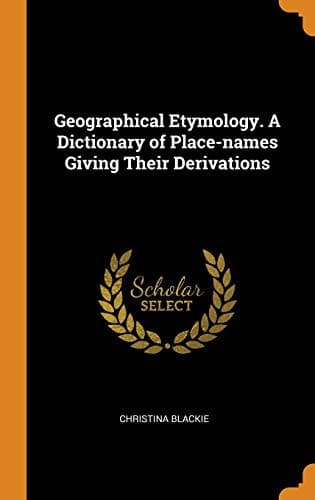
Geographical etymology: a dictionary of place-names giving their derivationsBlackie, Christina
History
Geographical etymology: a dictionary of place-names giving their derivations
Blackie, Christina
Names, Geographical
victory; _e.g._ Winford, Winslow, Wingrave, Wimborne (the ford, hill,
entrenchment, and brook of the victory).
[Sidenote: WINKEL (Ger.),
WINCEL (A.S.),]
a corner; _e.g._ Winceby (corner dwelling); Winchcomb (the corner
hollow); Winchelsea (the island or moist land at the corner);
Winchendon (corner hill); Winkleigh (corner meadow); Winkelhorst
(corner thicket); Winkeldorf (corner village); Winklarn (the waste
field at the corner).
[Sidenote: WISCH, or OSSICK,]
contracted from the Sclav. _hussoki_ (high); _e.g._ Wissek, Weissagh,
Wisowice or Wisowitz, Ossiegt, and Ossagh (high village); Wischhrad
(high fortress); Wisoki-mazo-wieck (the high middle market-town), in
Poland; but in Germany _wisch_ is sometimes a form of _wiese_ (meadow),
as in Wischmühle (the meadow mill); Wischhausen (the dwelling in the
meadow); Essek, for _Ossick_ (high place), in Sclavonia.
[Sidenote: WITHIG (A.S.),]
the willow; _e.g._ Witham, Withern (willow dwelling); Withybrook
(willow stream); Withridge (willow ridge).
[Sidenote: WOH (A.S.),]
a turning; _e.g._ Woburn, Wooburn (the bend of the stream); Woking
(the turning at the chink or chine).
[Sidenote: WOL (Sclav.),]
the ox; _e.g._ Wolgast (the oxen’s shed); Wohlau (an enclosure for
oxen), a town in Prussia which carries on a great trade in cattle;
Wollin (the place of oxen), at the mouth of the R. Oder.
[Sidenote: WOLSCHA, or OELZA (Sclav.),]
the alder-tree; _e.g._ Wolschau, Wolschen, Wolsching, Wolschinka (the
place abounding in alders); the Sclavonic name for the R. Elster is
_Wolshinka_ (the river of alders); Oels, in Silesia, on the Oelse
(alder-tree stream); Oelsen and Olsenice (the village of alder-trees);
Olsnitz (the town on Elster, or alder stream).
[Sidenote: WOLV, or WOL,]
a prefix sometimes employed with reference to the wolf, as in
Wolvesley (the wolves’ island), where a tribute of wolves’ heads was
paid annually by the Britons to the Saxons, by order of King Edgar.
Sometimes as a contraction for _wold_ (the waste land), as in Wolford,
Wolborough, Woldingham, Wooler, and in Woolverton; but it comes often
also from a personal name, as in Wolfhamcote, Wulferlow, Wolferton
(from Ulp or Wulfhern).
[Sidenote: WORTH, or WEORTHING (A.S.),]
a farm, manor, or estate, a place warded or protected, A.S. _warian_
(to defend); cognate with the Ger. _warid_ or _werder_; _e.g._ Worthing
in Sussex, Worthen in Salop, Worthy and Worting in Hants, Worthington
in Lancashire (the farm or manor); Highworth (high manor); Kenilworth
(the estate of Kenelm); Bosworth (of Bosa); Edgeworth (the estate on
the border); Edgeware, anc. _Edgeworth_, same meaning; Polwarth (the
estate on the marshy land), a parish in Berwickshire; Ravenworth (the
manor of Hrafen); Rickmansworth (of Rickman); Tamworth (the manor),
on R. Tam; Wandsworth, on the R. Wandle; Worksworth (the place near
the miner’s works); Chatsworth (the manor in the wood), Celtic _coed_;
Hammersmith, corrupt. from _Hermoderworth_ (the manor of Hermode).
Public-domain text, read in full here on John Shaqi.
Reviews
Reviews
No reviews yet
Be the first to share your thoughts on this work.
Elsewhere in the archive
Join the Discussion
Join the discussion
Sign in to leave a comment or review.
Sign InorCreate an account