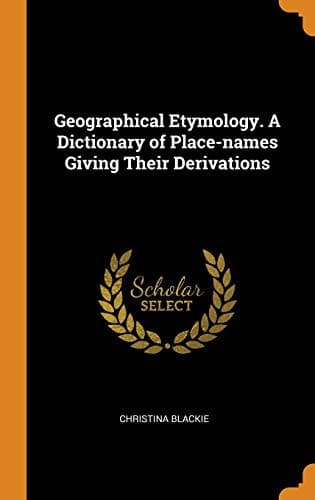
Geographical etymology: a dictionary of place-names giving their derivationsBlackie, Christina
History
Geographical etymology: a dictionary of place-names giving their derivations
Blackie, Christina
Names, Geographical
“After a careful examination, we are bound to say that it is the most
comprehensive, accurate, and methodical geography with which we are
familiar, and bears on every page unmistakable traces of careful and
industrious research. It fully sustains the high reputation of Mr.
Murray’s series of Manuals, and we venture to predict for it a wide
popularity. Bearing in mind its high character, it is a model of
cheapness.”--_School Guardian._
A SMALLER MANUAL OF MODERN GEOGRAPHY. By JOHN RICHARDSON. 16mo.
2s. 6d.
“We frankly acknowledge that we have never seen anything of its
kind, and for its space, at all approaching to this Smaller
Geography.”--_English Churchman._
THE STUDENT’S GEOGRAPHY OF BRITISH INDIA. By GEORGE SMITH, LL.D.
“This book is a marvel of labour and condensation, and its compiler
states that he has prepared himself for his task for more than twenty
years.”--_Spectator._
_ANCIENT._
THE STUDENT’S MANUAL OF ANCIENT GEOGRAPHY. By Canon W. L. BEVAN,
M.A. With 240 Maps and Woodcuts. Post 8vo. 7s. 6d.
By the Same Author.
A SMALLER MANUAL OF ANCIENT GEOGRAPHY. With Thirty Woodcuts. 240
pp. 16mo. 3s. 6d.
“A valuable addition to our geographical works. It contains the
newest and most reliable information derived from the researches of
modern travellers. No better text-book can be placed in the hands of
scholars.”--_Journal of Education._
PHYSICAL GEOGRAPHY. By MARY SOMERVILLE. Revised by JOHN
RICHARDSON. 548 pp. 9s.
“So far as general physical geography goes, such Manuals as those
of ... Mrs. Somerville leave little to be desired.”--Mr. J. S.
KELTIE’S _Report on Geographical Education_.
JOHN MURRAY, ALBEMARLE STREET, LONDON.
FOOTNOTES:
[1] _Ancient Books of Wales_, vol. i. p. 144, with reference to the
famous work of Chalmers, the _Caledonia_.
[2] _A_, signifying in possession, seems to be derived from _a_, Old
Norse, I have; _aga_, I possess. The Old English _awe_, to own, is
still retained in the north of England and in Aberdeenshire.
[3] Caer-afon (the fortress on the water) was its ancient name.
[4] It obtained the name from two large stones that lay on the roadside
near the church, and possessed that property.
[5] For the word _Beltein_, _v._ Joyce’s _Irish Names of Places_, vol.
i. p. 187; Chambers’s _Encyclopædia_; and Petrie’s _Round Towers of
Ireland_.
Transcriber’s Notes:
1. Obvious printers’, punctuation and spelling errors have been
corrected silently.
2. Some hyphenated and non-hyphenated versions of the same words have
been retained as in the original.
3. Italics are shown as _xxx_.
Public-domain text, read in full here on John Shaqi.
Reviews
Reviews
No reviews yet
Be the first to share your thoughts on this work.
Elsewhere in the archive
Join the Discussion
Join the discussion
Sign in to leave a comment or review.
Sign InorCreate an account