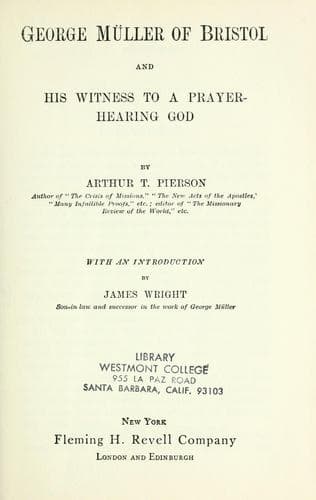
George Müller of Bristol, and His Witness to a Prayer-Hearing GodPierson, Arthur T. (Arthur Tappan)
Religion
George Müller of Bristol, and His Witness to a Prayer-Hearing God
Pierson, Arthur T. (Arthur Tappan)
Müller, George, 1805-1898; Orphanages -- Great Britain; Prayer
While at Plymouth Mr. Muller felt anew the impulse to early rising for
purposes of devotional communion. At Halle he had been an early riser,
influenced by zeal for excellence in study. Afterwards, when his weak
head and feeble nerves made more sleep seem needful, he judged that,
even when he rose late, the day would be long enough to exhaust his
little fund of strength; and so often he lay in bed till six or even
seven o'clock, instead of rising at four; and after dinner took a nap
for a quarter-hour. It now grew upon him, however, that he was losing in
spiritual vigour, and that his soul's health was declining under this
new regimen. The work now so pressed upon him as to prevent proper
reading of the Word and rob him of leisure for secret prayer.
A 'chance remark'--there is no _chance_ in a believer's life!--made by
the brother at whose house he was abiding at Plymouth, much impressed
him. Referring to the sacrifices in Leviticus, he said that, as the
refuse of the animals was never offered up on the altar, but only the
best parts and the fat, so the choicest of our time and strength, the
best parts of our day, should be especially given to the Lord in worship
and communion. George Muller meditated much on this; and determined,
even at the risk of damage to bodily health, that he would no longer
spend his best hours in bed. Henceforth he allowed himself but _seven
hours' sleep_ and gave up his after-dinner rest. This resumption of
early rising secured long seasons of uninterrupted interviews 'with God,
in prayer and meditation on the Scriptures, before breakfast and the
various inevitable interruptions that followed. He found himself not
worse but better, physically, and became convinced that to have lain
longer in bed as before would have kept his nerves weak; and, as to
spiritual life, such new vitality and vigour accrued from thus waiting
upon God while others slept, that it continued to be the habit of his
after-life.
In November, 1839, when the needs were again great and the supplies very
small, he was kept in peace: "I was not," he says, "looking at the
_little in hand, 'but at the fulness of God."_
It was his rule to empty himself of all that he had, in order to greater
boldness in appealing for help from above. All needless articles were
sold if a market could be found. But what was useful in the Lord's work
he did not reckon as needless, nor regard it right to sell, since the
Father knew the need. One of his fellow labourers had put forward his
valuable watch as a security for the return of money laid by for rent,
but drawn upon for the time; yet even this plan was not felt to be
scriptural, as the watch might be reckoned among articles needful and
useful in the Lord's service, and, if such, expedients were quite
abandoned, the deliverance would be more manifest as of the Lord. And
so, one by one, all resorts were laid aside that might imperil full
trust and sole dependence upon the one and only Helper.
Public-domain text, read in full here on John Shaqi.
Reviews
Reviews
No reviews yet
Be the first to share your thoughts on this work.
Elsewhere in the archive
Join the Discussion
Join the discussion
Sign in to leave a comment or review.
Sign InorCreate an account