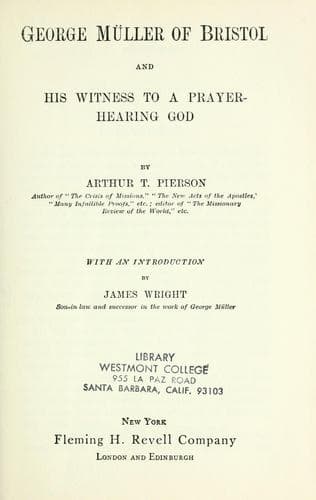
George Müller of Bristol, and His Witness to a Prayer-Hearing GodPierson, Arthur T. (Arthur Tappan)
Religion
George Müller of Bristol, and His Witness to a Prayer-Hearing God
Pierson, Arthur T. (Arthur Tappan)
Müller, George, 1805-1898; Orphanages -- Great Britain; Prayer
The first hour of his stay at Stuttgart brought to him one of the
sharpest trials of faith he had ever thus far experienced. The nature of
it he does not reveal in his journal, but it now transpires that it was
due to the recalling of the seven hundred pounds, the gift of which had
led to his going to Germany. This fact could not at the time be recorded
because the party would feel it a reproach. Nor was this the only test
of faith during his sojourn abroad; in fact so many, so great, so
varied, and so prolonged were some of these trials, as to call into full
exercise all the wisdom and grace which he had received from God, and
whatever lessons he had previously learned in the school of experience
became now of use. Yet not only was his peace undisturbed, but he bears
witness that the conviction so rooted itself in his inmost being that in
all this God's goodness was being shown, that he would have had nothing
different. The greatest trials bore fruit in the fullest blessings and
sometimes in clusters of blessings. It particularly moved him to adoring
wonder and praise to see God's wisdom in having delayed his visit until
the very time when it occurred. Had he gone any earlier he would have
gone too soon, lacking the full experience necessary to confront the
perplexities of his work. When darkness seemed to obscure his way, faith
kept him expectant of light, or at least of guidance in the darkness;
and he found that promise to be literally fulfilled:
"As thou goest, step by step, the way shall open up before thee." (See
the Hebrew, of Prov. iv. 12.)
At Stuttgart he found and felt, like Jude, that it was "needful
earnestly to contend for the faith once delivered to the saints." Even
among believers, errors had found far too deep root. Especially was
undue stress laid upon _baptism,_ which was made to occupy a prominence
and importance out of all due proportion of faith. One brother had been
teaching that without it there is no new birth, and that, consequently,
no one could, before baptism, claim the forgiveness of sins; that the
apostles were not born from above until the day of Pentecost, and that
our Lord Himself had not been new-born until His own baptism, and had
thence, for the rest of His mortal life, ceased to be under the law!
Many other fanciful notions were found to prevail, such as that baptism
is the actual death of the old man by drowning, and that it is a
covenant with the believer into which God enters; that it is a sin to
break bread with unbaptized believers or with members of the state
church; and that the bread and the cup used in the Lord's Supper not
only mean but are the very body and blood of the Lord, etc.
A more serious and dangerous doctrine which it was needful to confront
and confute was what Mr. Muller calls that "awful error," spread almost
universally among believers in that land, that at last "all will be
saved," not-sinful men only, but "even the devils themselves."
Public-domain text, read in full here on John Shaqi.
Reviews
Reviews
No reviews yet
Be the first to share your thoughts on this work.
Elsewhere in the archive
Join the Discussion
Join the discussion
Sign in to leave a comment or review.
Sign InorCreate an account