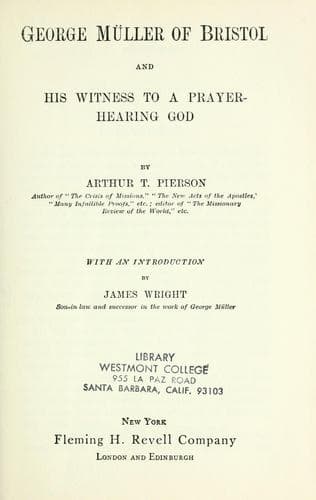
George Müller of Bristol, and His Witness to a Prayer-Hearing GodPierson, Arthur T. (Arthur Tappan)
Religion
George Müller of Bristol, and His Witness to a Prayer-Hearing God
Pierson, Arthur T. (Arthur Tappan)
Müller, George, 1805-1898; Orphanages -- Great Britain; Prayer
It is important also to observe that, if one branch of the work is in
straits, it is not necessarily a reason for abandoning another form of
service. The work of God depends on Him alone. If the whole tree is His
planting, we need not cut off one limb to save another. The whole body
is His, and, if one member is weak, it is not necessary to cut off
another to make it strong, for the strength of the whole body is the
dependence of every part. In our many-branching service each must get
vitality and vigour from the same source in God. Nevertheless let us not
forget that the _stops,_ as well as the _steps,_ of a good man are
ordered of the Lord. If the work is His work, let Him control it, and,
whether we expand or contract, let it be at His bidding, and a matter of
equal satisfaction to His servant.
CHAPTER XIV
GOD'S BUILDING: THE NEW ORPHAN HOUSES
How complex are the movements of God's providence! Some events are
themselves eventful. Like the wheels in Ezekiel's vision--a wheel in the
middle of a wheel,--they involve other issues within their mysterious
mechanism, and constitute epochs of history. Such an epochal event was
the building of the first of the New Orphan Houses on Ashley Down.
After October, 1845, it became clear to Mr. Muller that the Lord was
leading in this direction. Residents on Wilson Street had raised
objections to the noise made by the children, especially in play hours;
the playgrounds were no longer large enough for so many orphans; the
drainage was not adequate, nor was the situation of the rented houses
favourable, for proper sanitary conditions; it was also desirable to
secure ground for cultivation, and thus supply outdoor work for the
boys, etc. Such were some of the reasons which seemed to demand the
building of a new orphan house; and the conviction steadily gained
ground that the highest well-being of all concerned would be largely
promoted if a suitable site could be found on which to erect a building
adapted to the purpose.
There were objections to building which were carefully weighed: money in
large sums would be needed; planning and constructing would severely tax
time and strength; wisdom and oversight would be in demand at every
stage of the work; and the question arose whether such permanent
structures befit God's pilgrim people, who have here no continuing city
and believe that the end of all things is at hand.
Public-domain text, read in full here on John Shaqi.
Reviews
Reviews
No reviews yet
Be the first to share your thoughts on this work.
Elsewhere in the archive
Join the Discussion
Join the discussion
Sign in to leave a comment or review.
Sign InorCreate an account