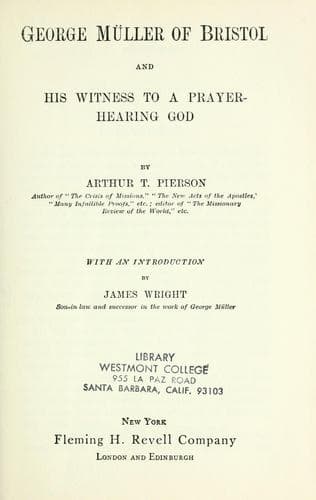
George Müller of Bristol, and His Witness to a Prayer-Hearing GodPierson, Arthur T. (Arthur Tappan)
Religion
George Müller of Bristol, and His Witness to a Prayer-Hearing God
Pierson, Arthur T. (Arthur Tappan)
Müller, George, 1805-1898; Orphanages -- Great Britain; Prayer
Scarcely were the orphans thus housed on Ashley Down, before Mr.
Muller's heart felt enlarged desire that one thousand, instead of three
hundred, might enjoy such privileges of temporal provision and spiritual
instruction; and, before the new year, 1851, had dawned, this yearning
had matured into a purpose. With his uniform carefulness and
prayerfulness, he sought to be assured that he was not following
self-will, but the will of God; and again in the scales of a pious
judgment the reasons for and against were conscientiously weighed. Would
he be going 'beyond his measure,' spiritually, or naturally? Was not the
work, with its vast correspondence and responsibility, already
sufficiently great? Would not a new orphan house for three hundred
orphans cost another fifteen thousand pounds, or, if built for seven
hundred, with the necessary ground, thirty-five thousand? And, even when
built and fitted and filled, would there not be the providing for daily
wants, which is a perpetual care, and cannot be paid for at once like a
site and a building? It would demand eight thousand pounds annual outlay
to provide for another seven hundred little ones. To all objections the
one all-sufficient answer was the all-sufficient God; and, because Mr.
Muller's eye was on His power, wisdom, and riches, his own weakness,
folly, and poverty were forgotten. Another objection was suggested: What
if he should succeed in thus housing and feeding a thousand poor waifs,
what would become of the institution _after his death?_ The reply is
memorable: "My business is, with all my might, to _serve my own
generation by the will of God:_ in so doing I shall best serve the next
generation, should the Lord Jesus tarry." Were such objection valid, it
were as valid against beginning any work likely to outlive the worker.
And Mr. Muller remembered how Francke at Halle had to meet the same
objection when, now over two hundred years ago, he founded the largest
charitable establishment which, up to 1851, existed in the world. But
when, after about thirty years of personal superintendence, Francke was
taken away, his son-in-law, as we have seen, became the director. That
fellow countryman who had spoken to Mr. Muller's soul in 1826, thus
twenty-five years later encouraged him to go forward, to do his own duty
and leave the future to the Eternal God.
Public-domain text, read in full here on John Shaqi.
Reviews
Reviews
No reviews yet
Be the first to share your thoughts on this work.
Elsewhere in the archive
Join the Discussion
Join the discussion
Sign in to leave a comment or review.
Sign InorCreate an account