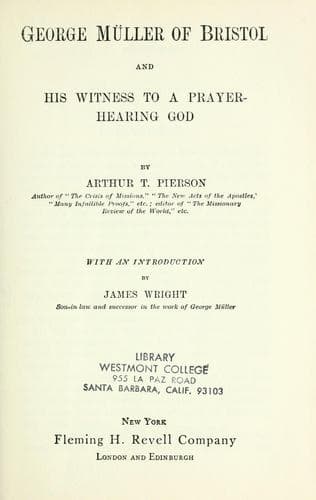
George Müller of Bristol, and His Witness to a Prayer-Hearing GodPierson, Arthur T. (Arthur Tappan)
Religion
George Müller of Bristol, and His Witness to a Prayer-Hearing God
Pierson, Arthur T. (Arthur Tappan)
Müller, George, 1805-1898; Orphanages -- Great Britain; Prayer
But, more than this, a moment's serious thought will show that, had he
surrounded them with those elegancies which elaborate architecture and
the other fine arts furnish, he might have been even more severely
criticised. He would have been spending the gifts of the poor who often
sorely denied themselves for the sake of these orphans, to purchase
embellishments or secure decorations which, if they had adorned the
humble homes of thousands of donors, would have made their gifts
impossible. When we remember how many offerings, numbering tens of
thousands, were, like the widow's mites, very small in themselves, yet,
relatively to ability, very large, it will be seen how incongruous it
would have been to use the gifts, saved only by limiting even the wants
of the givers, to buy for the orphans what the donors could not and
would not afford for themselves.
Cleanness, neatness, method, and order, however, everywhere reign, and
honest labour has always had, at the orphan houses, a certain dignity.
The tracts of land, adjoining the buildings, are set apart as
vegetable-gardens, where wholesome exercise is provided for the orphan
boys, and, at the same time, work that helps to provide daily food, and
thus train them in part to self-support.
Throughout these houses studious care is exhibited, as to methodical
arrangement. Each child has a square and numbered compartment for
clothes, six orphans being told off, at a time, in each section, to take
charge. The boys have each three suits, and the girls, five dresses
each, the girls being taught to make and mend their own garments. In the
nursery, the infant children have books and playthings to occupy and
amuse them, and are the objects of tender maternal care. Several
children are often admitted to the orphanage from one family, in order
to avoid needless breaking of household ties by separation. The average
term of residence is about ten years, though some orphans have been
there for seventeen.
Public-domain text, read in full here on John Shaqi.
Reviews
Reviews
No reviews yet
Be the first to share your thoughts on this work.
Elsewhere in the archive
Join the Discussion
Join the discussion
Sign in to leave a comment or review.
Sign InorCreate an account