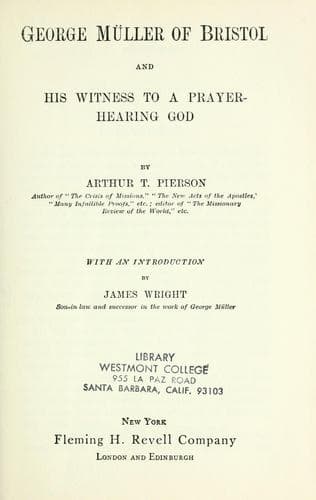
George Müller of Bristol, and His Witness to a Prayer-Hearing GodPierson, Arthur T. (Arthur Tappan)
Religion
George Müller of Bristol, and His Witness to a Prayer-Hearing God
Pierson, Arthur T. (Arthur Tappan)
Müller, George, 1805-1898; Orphanages -- Great Britain; Prayer
The common ways of accounting for its success would be absurdly
ridiculous and amusing were they not so sadly unbelieving. Those who
knew little or nothing, either of the exercise of faith or the
experience of God's faithfulness, resorted to the most God-dishonouring
explanations of the work. Some said: "Mr. Muller is a foreigner; his
methods are so novel as to attract attention." Others thought that the
"Annual Reports brought in the money," or suggested that he had "a
_secret treasure."_ His quiet reply was, that his being a foreigner
would be more likely to repel than to attract confidence; that the
novelty would scarcely avail him after more than a score of years; that
other institutions which issued reports did not always escape want and
debt; but, as to the secret treasure to which he was supposed to have
access, he felt constrained to confess that there was _more in that
supposition than the objectors were aware of._ He had indeed a Treasury,
inexhaustible--in the promises of a God unchangeably faithful--from
which he admits that he had already in 1856 drawn for twenty-two years,
and in all over one hundred and thirteen thousand pounds. As to the
Reports, it may be worth while to notice that he never but once in his
life advertised the public of any need, and that was the _need of more
orphans_--more to care for in the name of the Lord--a single and
singular ease of advertising, by which he sought not to increase his
_income,_ but his _expenditure_--not asking the public to aid him in
supporting the needy, but to increase the occasion of his outlay!
So far was he from depending upon any such sources of supply as the
unbelieving world might think, that it was in the drying up of all such
channels that he found the opportunity of his faith and of God's power.
The visible treasure was often so small that it was reduced to nothing,
but the invisible Treasure was God's riches in glory, and could be drawn
from without limit. This it was to which he looked alone, and in which
he felt that he had a river of supply that can never run dry.*
* Appendix H.
The orphan work had, to Mr. Muller, many charms which grew on him as he
entered more fully into it. While his main hope was to be the means of
spiritual health to these children, he had the joy of seeing how God
used these homes for the promotion of their physical welfare also, and,
in cases not a few, for the entire renovation of their weak and diseased
bodies. It must be remembered that most of them owed their orphan
condition to that great destroyer, Consumption. Children were often
brought to the orphan houses thoroughly permeated by the poison of bad
blood, with diseased tendencies, and sometimes emaciated and
half-starved, having had neither proper food nor medical care.
Public-domain text, read in full here on John Shaqi.
Reviews
Reviews
No reviews yet
Be the first to share your thoughts on this work.
Elsewhere in the archive
Join the Discussion
Join the discussion
Sign in to leave a comment or review.
Sign InorCreate an account