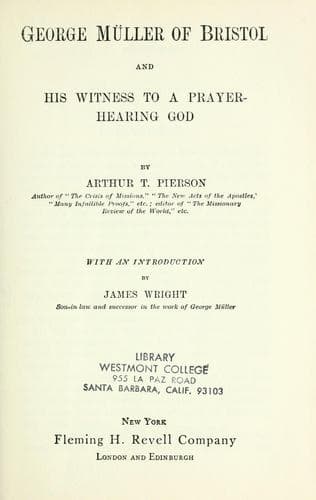
George Müller of Bristol, and His Witness to a Prayer-Hearing GodPierson, Arthur T. (Arthur Tappan)
Religion
George Müller of Bristol, and His Witness to a Prayer-Hearing God
Pierson, Arthur T. (Arthur Tappan)
Müller, George, 1805-1898; Orphanages -- Great Britain; Prayer
That severe and epidemic disease should find its way into the orphanages
at all may seem strange to those who judge God's faithfulness by
appearances, but many were the compensations for such trials. By them
not only were the hearts of the children often turned to God, but the
hearts of helpers in the Institution were made more sympathetic and
tender, and the hearts of God's people at large were stirred up to
practical and systematic help. God uses such seeming calamities as
'advertisements' of His work; many who would not have heard of the
Institution, or on whom what they did hear would have made little
impression, were led to take a deep interest in an orphanage where
thousands of little ones were exposed to the ravages of some malignant
and dangerous epidemic.
Looking back, in 1865, after thirty-one years, upon the work thus far
done for the Lord, Mr. Muller gratefully records that, during the entire
time, he had been enabled to hold fast the original principles on which
the work was based on March 5, 1834. He had never once gone into debt;
he had sought for the Institution no patron but the Living God; and he
had kept to the line of demarcation between believers and unbelievers,
in all his seeking for active helpers in the work.
His grand purpose, in all his labours, having been, from the beginning,
the glory of God, in showing what could be done through prayer and
faith, without any leaning upon man, his unequivocal testimony is:
"Hitherto hath the Lord helped us." Though for about five years they
had, almost daily, been in the constant trial of faith, they were as
constantly proving His faithfulness. The work had rapidly grown, till it
assumed gigantic proportions, but so did the help of God keep pace with
all the needs and demands of its growth.
In January, 1866, Mr. Henry Craik, who had for thirty-six years been Mr.
Muller's valued friend, and, since 1832, his coworker in Bristol, fell
asleep after an illness of seven months. In Devonshire these two
brethren had first known each other, and the acquaintance had
subsequently ripened, through years of common labour and trial, into an
affection seldom found among men. They were nearly of an age, both being
a little past sixty when Mr. Craik died. The loss was too heavy to have
been patiently and serenely borne, had not the survivor known and felt
beneath him the Everlasting Arms. And even this bereavement, which in
one aspect was an irreparable loss, was seen to be only another proof of
God's love. The look ahead might be a dark one, the way desolate and
even dangerous, but goodness and mercy were still following very close
behind, and would in every new place of danger or difficulty be at hand
to help over hard places and give comfort and cheer in the night season.
CHAPTER XVI
THE SHADOW OF A GREAT SORROW
Public-domain text, read in full here on John Shaqi.
Reviews
Reviews
No reviews yet
Be the first to share your thoughts on this work.
Elsewhere in the archive
Join the Discussion
Join the discussion
Sign in to leave a comment or review.
Sign InorCreate an account