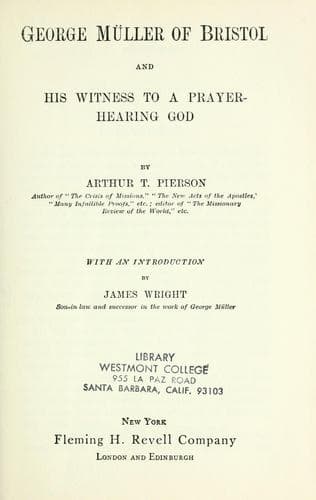
George Müller of Bristol, and His Witness to a Prayer-Hearing GodPierson, Arthur T. (Arthur Tappan)
Religion
George Müller of Bristol, and His Witness to a Prayer-Hearing God
Pierson, Arthur T. (Arthur Tappan)
Müller, George, 1805-1898; Orphanages -- Great Britain; Prayer
The death of this beloved wife afforded an illustration of this. Within
a few hours after this withdrawal of her who had shared with him the
planning and working of these long years of service, Mr. Muller went to
the Monday-evening prayer meeting, then held in Salem Chapel, to mingle
his prayers and praises as usual with those of his brethren. With a
literally shining countenance, he rose and said: "Beloved brethren and
sisters in Christ, I ask you to join with me in hearty praise and
thanksgiving to my precious Lord for His loving kindness in having taken
my darling, beloved wife out of the pain and suffering which she has
endured, into His own presence; and as I rejoice in everything that is
for her, happiness, so I now rejoice as I realize how far happier she
is, in beholding her Lord whom she loved so well, than in any joy she
has known or could know here. I ask you also to pray that the Lord will
so enable me to have fellowship in her joy that my bereaved heart may be
occupied with her blessedness instead of my unspeakable loss." These
remarkable words are supplied by one who was himself present and on
whose memory they made an indelible impression.
This occurrence had a marked effect upon all who were at that meeting.
Mrs. Muller was known by all as a most valuable, lovely, and holy woman
and wife. After nearly forty years of wedded life and love, she had left
the earthly home for the heavenly. To her husband she had been a
blessing beyond description, and to her daughter Lydia, at once a wise
and tender mother and a sympathetic companion. The loss to them both
could never be made up on earth. Yet in these circumstances this man of
God had grace given to forget his own and his daughter's irreparable
loss, and to praise God for the unspeakable gain to the departed wife
and mother.
The body was laid to rest on February 11th, many thousands of sorrowing
friends evincing the deepest sympathy. Twelve hundred orphans mingled in
the funeral procession, and the whole staff of helpers so far as they
could be spared from the houses. The bereaved husband strangely upheld
by the arm of the Almighty Friend in whom he trusted, took upon himself
the funeral service both at chapel and cemetery. He was taken seriously
ill afterward, but, as soon as his returning strength allowed, he
preached his wife's funeral sermon--another memorable occasion. It was
the supernatural serenity of his peace in the presence of such a
bereavement that led his attending physician to say to a friend, "I have
never before seen so _unhuman_ a man." Yes, _un_human indeed, though far
from _in_human, lifted above the weakness of mere humanity by a power
not of man.
That funeral sermon was a noble tribute to the goodness of the Lord even
in the great affliction of his life. The text was:
_"Thou art good and doest good."_ (Psalm cxix. 68.)
Public-domain text, read in full here on John Shaqi.
Reviews
Reviews
No reviews yet
Be the first to share your thoughts on this work.
Elsewhere in the archive
Join the Discussion
Join the discussion
Sign in to leave a comment or review.
Sign InorCreate an account