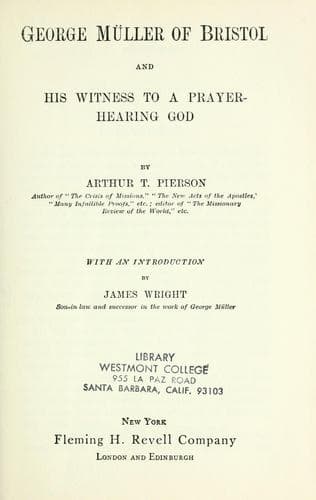
George Müller of Bristol, and His Witness to a Prayer-Hearing GodPierson, Arthur T. (Arthur Tappan)
Religion
George Müller of Bristol, and His Witness to a Prayer-Hearing God
Pierson, Arthur T. (Arthur Tappan)
Müller, George, 1805-1898; Orphanages -- Great Britain; Prayer
In another connection it has already been recorded that, when at
Jubbulpore in 1890, Mr. Muller received tidings of his daughter's death.
To any man of less faith that shock might have proved, at his advanced
age, not only a stunning but a fatal blow. His only daughter and only
child, Lydia, the devoted wife of James Wright, had been called home, in
her fifty-eighth year, and after nearly thirty years of labour at the
orphan houses. What this death meant to Mr. Muller, at the age of
eighty-four, no one can know who has not witnessed the mutual devotion
of that daughter and that father: and what that loss was to Mr. Wright,
the pen alike fails to portray. If the daughter seemed to her father
humanly indispensable, she was to her husband a sort of inseparable part
of his being; and over such experiences as these it is the part of
delicacy to draw the curtain of silence. But it should be recorded that
no trait in Mrs. Wright was more pathetically attractive than her
humility. Few disciples ever felt their own nothingness as she did, and
it was this ornament of a meek and quiet spirit--the only ornament she
wore--that made her seem so beautiful to all who knew her well enough
for this 'hidden man of the heart' to be disclosed to their vision. Did
not that ornament in the Lord's sight appear as of great price? Truly
"the beauty of the Lord her God was upon her."
James Wright had lived with his beloved Lydia for more than eighteen
years, in "unmarred and unbroken felicity." They had together shared in
prayers and tears before God, bearing all life's burdens in common. Weak
as she was physically, he always leaned upon her and found her a tower
of spiritual strength in time of heavy responsibility. While, in her
lowly-mindedness, she thought of herself as a 'little useless thing,' he
found her both a capable and cheerful supervisor of many most important
domestic arrangements where a competent woman's hand was needful: and,
with rare tact and fidelity, she kept watch of the wants of the orphans
as her dear mother had done before her. After her decease, her husband
found among her personal effects a precious treasure--a verse written
with her own hand:
"I have seen the face of Jesus,
Tell me not of aught beside;
I have heard the voice of Jesus,
All my soul is satisfied."
This invaluable little fragment, like that other writing found by this
beloved daughter among her mother's effects, became to Mr. Wright what
that had been to Mr. Muller, a sort of last legacy from his departed and
beloved wife. Her desires were fulfilled; she had seen the face and
heard the voice of Him who alone could satisfy her soul.
Public-domain text, read in full here on John Shaqi.
Reviews
Reviews
No reviews yet
Be the first to share your thoughts on this work.
Elsewhere in the archive
Join the Discussion
Join the discussion
Sign in to leave a comment or review.
Sign InorCreate an account