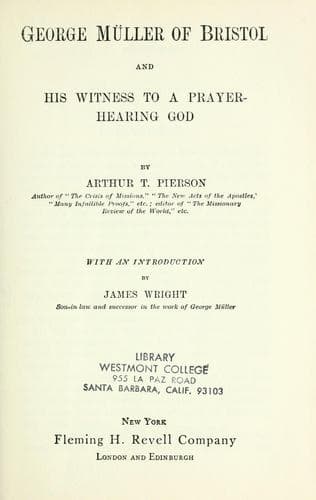
George Müller of Bristol, and His Witness to a Prayer-Hearing GodPierson, Arthur T. (Arthur Tappan)
Religion
George Müller of Bristol, and His Witness to a Prayer-Hearing God
Pierson, Arthur T. (Arthur Tappan)
Müller, George, 1805-1898; Orphanages -- Great Britain; Prayer
This is a record of personal gifts to which we know no parallel. It
reminds us of the career of John Wesley, whose simplicity and frugality
of habits enabled him not only to limit his own expenditure to a very
small sum, but whose Christian liberality and unselfishness prompted him
to give all that he could thus save to purely benevolent
objects. While he had but thirty pounds a year, he lived on twenty-eight
and gave away forty shillings. Receiving twice as much the next year, he
still kept his living expenses down to the twenty-eight pounds and had
thirty-two to bestow on the needy; and when the third year his income
rose to ninety pounds, he spent no more than before and gave away
sixty-two. The fourth year brought one hundred and twenty, and he
disbursed still but the same sum for his own needs, having ninety-two to
spare. It is calculated that in the course of his life he thus gave away
at least thirty thousand pounds, and four silver spoons comprised all
the silver plate that he possessed when the collectors of taxes called
upon him. Such economy on the one hand and such generosity on the other
have seldom been known in human history. But George Muller's record will
compare favourably with this or any other of modern days. His frugality,
simplicity, and economy were equal to Wesley's, and his gifts aggregated
eighty-one thousand pounds. Mr. Muller had received increasingly large
sums from the Lord which he _invested_ well and most profitably, so that
for over sixty years he never lost a penny through a bad speculation!
But his investments were not in lands or banks or railways, but in the
_work of God._ He made friends out of the mammon of unrighteousness that
when he failed received him into everlasting habitations. He continued,
year after year, to make provision for himself, his beloved wife and
daughter, by laying up treasure--in heaven. Such a man had certainly a
right to exhort others to systematic beneficence. He gave--as not one in
a million gives--not a tithe, not any fixed proportion of annual income,
but _all that was left_ after the simplest and most necessary supply of
actual wants. While most Christians regard themselves as doing their
duty if, after they have given a portion to the Lord, they spend all the
rest on themselves, God led George Muller to reverse this rule and
reserve only the most frugal sum for personal needs, that the entire
remainder might be given to him that needeth. The utter _revolution_
implied in our habits of giving which would be necessary were such a
rule adopted is but too obvious. Mr. Muller's own words are:
"My aim never was, how much I could _obtain,_ but rather how much I
could give."
Public-domain text, read in full here on John Shaqi.
Reviews
Reviews
No reviews yet
Be the first to share your thoughts on this work.
Elsewhere in the archive
Join the Discussion
Join the discussion
Sign in to leave a comment or review.
Sign InorCreate an account