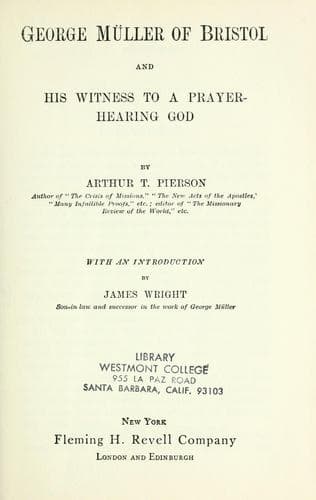
George Müller of Bristol, and His Witness to a Prayer-Hearing GodPierson, Arthur T. (Arthur Tappan)
Religion
George Müller of Bristol, and His Witness to a Prayer-Hearing God
Pierson, Arthur T. (Arthur Tappan)
Müller, George, 1805-1898; Orphanages -- Great Britain; Prayer
Such blessed results are largely due to these beloved colleagues in
labour who never withheld their testimony, but were intrepidly
courageous and conscientiously faithful in witnessing against whatever
they deemed opposed to the Word. Love ruled, but was not confounded with
laxity in matters of right and wrong; and, as they saw more clearly what
was taught in the Word, they sought to be wholly obedient to the Lord's
teaching and leading, and to mould and model every matter, however
minute, in every department of duty, private or public, according to the
expressed will of God.
In January, 1834, all teachers who were not believers were dismissed
from the Sunday-school; and, in the Dorcas Society, only believing
sisters were accepted to make clothes for the destitute. The reason was
that it had been found unwise and unwholesome to mix up or yoke together
believers and unbelievers.* Such association proved a barrier to
spiritual converse and injurious to both classes, fostering in the
unbelievers a false security, ensnaring them in a delusive hope that to
help in Christian work might somehow atone for rejection of Jesus Christ
as a Saviour, or secure favour from God and an open door into heaven. No
doubt all this indiscriminate association of children of God with
children of the world in a "mixed multitude" is unscriptural.
Unregenerate persons are tempted to think there is some merit at least
in mingling with worshippers and workers, and especially in giving to
the support of the gospel and its institutions. The devil seeks to
persuade such that it is acceptable to God to conform externally to
religious rites, and forms, and take part in outward acts of service and
sacrifice, and that He will deal leniently with them, despite their
unbelief and disobedience. Mr. Muller and Mr. Craik felt keenly that
this danger existed and that even in minor matters there must be a line
of separation, for the sake of all involved.
* 2 Cor. vi. 14-18.
When, in 1837, in connection with the congregation at Bethesda, the
question was raised--commonly known as that of close communion--whether
believers who had not been baptized as such should be received into
fellowship, it was submitted likewise to the one test of clear scripture
teaching. Some believers were conscientiously opposed to such reception,
but the matter was finally and harmoniously settled by "receiving all
who love our Lord Jesus into full communion, irrespective of baptism,"
and Mr. Muller, looking back forty-four years later upon this action,
bears witness that the decision never became a source of dissension.*
* Appendix L.
Public-domain text, read in full here on John Shaqi.
Reviews
Reviews
No reviews yet
Be the first to share your thoughts on this work.
Elsewhere in the archive
Join the Discussion
Join the discussion
Sign in to leave a comment or review.
Sign InorCreate an account