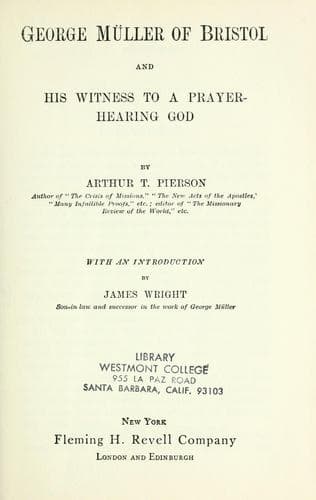
George Müller of Bristol, and His Witness to a Prayer-Hearing GodPierson, Arthur T. (Arthur Tappan)
Religion
George Müller of Bristol, and His Witness to a Prayer-Hearing God
Pierson, Arthur T. (Arthur Tappan)
Müller, George, 1805-1898; Orphanages -- Great Britain; Prayer
Perhaps it is well here to put on record, even at risk of repetition,
the principles which Mr. Muller and his colleague were wont to enforce
as guards or landmarks which should be set up and kept up, in order to
exclude those innovations which always bring spiritual declension.
1. Believers should meet, simply as such, without reference to
denominational lines, names, or distinctions, as a corrective and
preventive of sectarianism.
2. They should steadfastly maintain the Holy Scriptures as the divine
rule and standard of doctrine, deportment, and discipline.
3. They should encourage freedom for the exercise of whatever spiritual
gifts the Lord might be pleased by His Spirit to bestow for general
edification.
4. Assemblies on the Lord's day should be primarily for believers, for
the breaking of bread, and for worship; unbelievers sitting
promiscuously among saints would either hinder the appearance of meeting
for such purposes, or compel a pause between other parts of the service
and the Lord's Supper.
5. The pew-rent system should be abolished, as promoting the caste
spirit, or at least the outward appearance of a false distinction
between the poorer and richer classes, especially as pew-holders
commonly look on their sittings as private property.
6. All money contributed for pastoral support, church work, and
missionary enterprises at home and abroad should be by free-will
offerings.
It was because some of these and other like scriptural principles were
thought to be endangered or compromised by practices prevailing at
Gideon Chapel before Mr. Muller and Mr. Craik took charge, that it
seemed best on the whole to relinquish that chapel as a place of
worship. As certain customs there obtaining had existed previously, it
seemed to these godly-minded brethren that it would be likely to cause
needless offence and become a root of bitterness should they require
what they deemed unscriptural to be renounced; and it seemed the way of
love to give up Gideon Chapel after these eight years of labour there,
and to invite such as felt called on to separate from every sectarian
system, and meet for worship where free exercise would be afforded for
every spiritual gift, and where New Testament methods might be more
fully followed, to assemble with other believers at Bethesda, where
previous hindering conditions had not existed.
Mr. Muller remained very intimately connected with Bethesda and its
various outgrowths, for many years, as the senior pastor, or
elder,--though only _primus inter pares,_ i.e., leader among equals. His
opinions about the work of the ministry and the conduct of church-life,
which did so much to shape the history of these churches, therefore form
a necessary part of this sketch of the development of church-life.
Public-domain text, read in full here on John Shaqi.
Reviews
Reviews
No reviews yet
Be the first to share your thoughts on this work.
Elsewhere in the archive
Join the Discussion
Join the discussion
Sign in to leave a comment or review.
Sign InorCreate an account