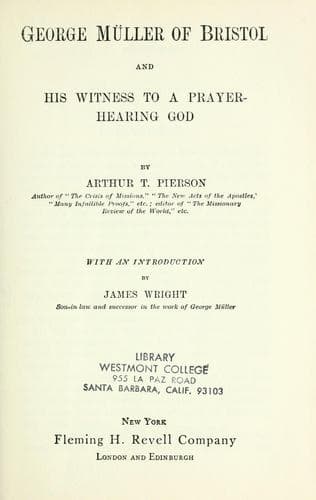
George Müller of Bristol, and His Witness to a Prayer-Hearing GodPierson, Arthur T. (Arthur Tappan)
Religion
George Müller of Bristol, and His Witness to a Prayer-Hearing God
Pierson, Arthur T. (Arthur Tappan)
Müller, George, 1805-1898; Orphanages -- Great Britain; Prayer
The humility Mr. Muller enjoined he practised. He was ever only the
_servant_ of the Lord. Mr. Spurgeon, in one of his sermons, describes
the startling effect on London Bridge when he saw one lamp after another
lit up with flame, though in the darkness he could not see the
lamplighter; and George Muller set many a light burning when he was
himself content to be unseen, unnoticed, and unknown. He honestly sought
not his own glory, but had the meek and quiet spirit so becoming a
minister of Jesus Christ.
Mr. Henry Craik's death in 1866, after thirty-four years of co-labour in
the Lord, left Mr. Muller comparatively alone with a double burden of
responsibility, but his faith was equal to the crisis and his peace
remained unbroken. A beloved brother, then visiting Bristol, after
crowded services conducted by him at Bethesda, was about leaving the
city; and he asked Mr. Muller, "What are you going to do, now that Mr.
Craik is dead, to hold the people and prevent their scattering?" "My
beloved brother," was the calm reply, "we shall do what we have always
done, _look only to the Lord."_
This God has been the perpetual helper. Mr. Muller almost totally
withdrew from the work, during the seventeen years of his missionary
tours, between 1875 and 1892, when he was in Bristol but a few weeks or
months at a time, in the intervals between his long journeys and
voyages. This left the assembly of believers still more dependent upon
the great Shepherd and Bishop of souls. But Bethesda has never, in a
sense, been limited to any one or two men, as the only acknowledged
leaders; from the time when those seven believers gathered about the
Lord's table in 1832, the New Testament conception of the equality of
believers in privilege and duty has been maintained. The one supreme
Leader is the Holy Ghost, and under Him those whom He calls and
qualifies. One of the fundamental principles espoused by these brethren
is that the Spirit of God controls in the assemblies of the saints; that
He sets the members, every one of them, in the Body as it pleaseth Him,
and divides unto them, severally as He will, gifts for service in the
Body; that the only true ordination is His ordination, and that the
manifestation of His gifts is the sufficient basis for the recognition
of brethren as qualified for the exercise of an office or function, the
possession of spiritual gifts being sufficient authority for their
exercise. It is with the Body of Christ as with the human body: the eye
is manifestly made for seeing and the ear for hearing, the hand and foot
for handling and walking; and this adaptation both shows the design of
God and their place in the organism. And so for more than threescore
years the Holy Spirit has been safely trusted to supply and qualify all
needed teachers, helpers, and leaders in the assembly. There has always
been a considerable number of brethren and sisters fitted and disposed
to take up the various departments of service to which they were
Public-domain text, read in full here on John Shaqi.
Reviews
Reviews
No reviews yet
Be the first to share your thoughts on this work.
Elsewhere in the archive
Join the Discussion
Join the discussion
Sign in to leave a comment or review.
Sign InorCreate an account