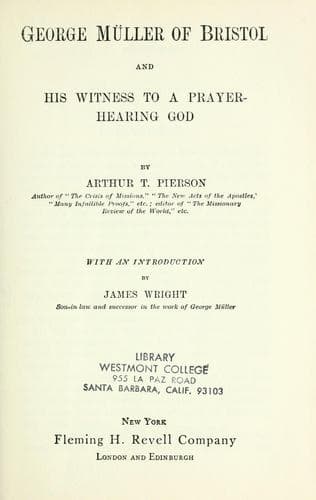
George Müller of Bristol, and His Witness to a Prayer-Hearing GodPierson, Arthur T. (Arthur Tappan)
Religion
George Müller of Bristol, and His Witness to a Prayer-Hearing God
Pierson, Arthur T. (Arthur Tappan)
Müller, George, 1805-1898; Orphanages -- Great Britain; Prayer
First, because it shows that the writer has disciplined himself to
accuracy of statement. Many a falsehood is not an intentional lie, but
an undesigned inaccuracy. Three of our human faculties powerfully affect
our veracity: one is memory, another is imagination, and another is
conscience. Memory takes note of facts, imagination colours facts with
fancies, and conscience brings the moral sense to bear in sifting the
real from the unreal. Where conscience is not sensitive and dominant,
memory and imagination will become so confused that facts and fancies
will fail to be separated. The imagination will be so allowed to invest
events and experiences with either a halo of glory or a cloud of
prejudice that the narrator will constantly tell, not what he clearly
sees written in the book of his remembrance, but what he beholds painted
upon the canvas of his own imagination. Accuracy will be, half
unconsciously perhaps, sacrificed to his own imaginings; he will
exaggerate or depreciate--as his own impulses lead him; and a man who
would not deliberately lie may thus be habitually untrustworthy: you
cannot tell, and often he cannot tell, what the exact truth would be,
when all the unreality with which it has thus been invested is
dissipated like the purple and golden clouds about a mountain, leaving
the bare crag of naked rock to be seen, just as it is in itself.
George Muller felt the immense importance of exact statement. Hence he
disciplined himself to accuracy. Conscience presided over his narrative,
and demanded that everything else should be scrupulously sacrificed to
veracity. But, more than this, God made him, in a sense, a _man without
imagination_--comparatively free from the temptations of an enthusiastic
temperament. He was a mathematician rather than a poet, an artisan
rather than an artist, and he did not see things invested with a false
halo. He was deliberate, not impulsive; calm and not excitable. He
naturally weighed every word before he spoke, and scrutinized every
statement before he gave it form with pen or tongue. And therefore the
very qualities that, to some people, may make his narrative bare of
charm, and even repulsively prosaic, add to its value as a plain,
conscientious, unimaginative, unvarnished, and trustworthy statement of
facts. Had any man of a more poetic mind written that journal, the
reader would have found himself constantly and unconsciously making
allowance for the writer's own enthusiasm, discounting the facts,
because of the imaginative colouring. The narrative might have been more
readable, but it would not have been so reliable; and, in this story of
the Lord's dealings, nothing was so indispensable as exact truth. It
would be comparatively worthless, were it not undeniable. The Lord
fitted the man who lived that life of faith and prayer, and wrote that
life-story, to inspire confidence, so that even skeptics and doubters
felt that they were reading, not a novel or a poem, but a history.
Public-domain text, read in full here on John Shaqi.
Reviews
Reviews
No reviews yet
Be the first to share your thoughts on this work.
Elsewhere in the archive
Join the Discussion
Join the discussion
Sign in to leave a comment or review.
Sign InorCreate an account