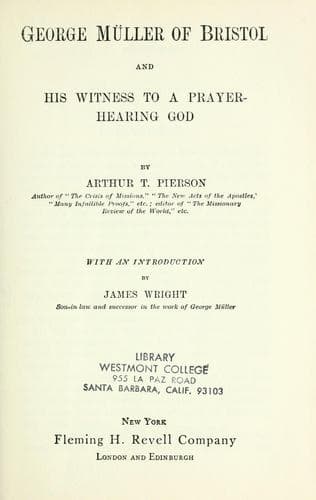
George Müller of Bristol, and His Witness to a Prayer-Hearing GodPierson, Arthur T. (Arthur Tappan)
Religion
George Müller of Bristol, and His Witness to a Prayer-Hearing God
Pierson, Arthur T. (Arthur Tappan)
Müller, George, 1805-1898; Orphanages -- Great Britain; Prayer
_Love,_ the third of that trinity of graces, was the other great secret
and lesson of this life. And what is love? _Not_ merely a complacent
affection for what is lovable, which is often only a half-selfish taking
of pleasure in the society and fellowship of those who love us. Love is
the _principle of unselfishness:_ love 'seeketh not her own'; it is the
preference of another's pleasure and profit over our own, and hence is
exercised toward the unthankful and unlovely, that it may lift them to a
higher level. Such love is benevolence rather than complacence, and so
it is "of God," for He loveth the unthankful and the evil: and he that
loveth is born of God and knoweth God. Such love is obedience to a
principle of unselfishness, and makes self-sacrifice habitual and even
natural. While Satan's motto is 'Spare thyself!' Christ's motto is to
Deny thyself!' The sharpest rebuke ever administered by our Lord was
that to Peter when he became a Satan by counselling his Master to adopt
Satan's maxim.* We are bidden by Paul, _"Remember Jesus Christ,"_** and
by Peter, _"Follow His steps."_*** If we seek the inmost meaning of these
two brief mottoes, we shall find that, about Jesus Christ's character,
nothing was more conspicuous than the obedience of faith and
self-surrender to God: and in His career, which we are bidden to follow,
the renunciation of love, or self-sacrifice for man. The taunt was
sublimely true: "He saved others, Himself He cannot save"; it was
_because_ he saved others that He could not save Himself. The seed must
give up its own life for the sake of the crop; and he who will be life
to others must, like his Lord, consent to die.
* Matt. xvi.
** 2 Tim. II. (Greek).
*** 1 Pet. II. 21.
Here is the real meaning of that command, "Let him deny himself and take
up his cross." Self-denial is not cutting off an indulgence here and
there, but laying the axe at the root of the tree of self, of which all
indulgences are only greater or smaller branches. Self-righteousness and
self-trust, self-seeking and self-pleasing, self-will, self-defence,
self-glory--these are a few of the myriad branches of that deeply rooted
tree. And what if one or more of these be cut off, if such lopping off
of some few branches only throws back into others the self-life to
develop more vigorously in them?
Public-domain text, read in full here on John Shaqi.
Reviews
Reviews
No reviews yet
Be the first to share your thoughts on this work.
Elsewhere in the archive
Join the Discussion
Join the discussion
Sign in to leave a comment or review.
Sign InorCreate an account