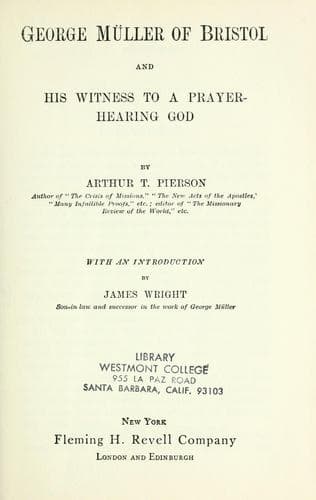
George Müller of Bristol, and His Witness to a Prayer-Hearing GodPierson, Arthur T. (Arthur Tappan)
Religion
George Müller of Bristol, and His Witness to a Prayer-Hearing God
Pierson, Arthur T. (Arthur Tappan)
Müller, George, 1805-1898; Orphanages -- Great Britain; Prayer
for the welfare of man, and herein lay his whole secret.
* Coloss. 1: 24.
To one who asked him the secret of his service he said: "There was a day
when I died, _utterly died;"_ and, as he spoke, he bent lower and lower
until he almost touched the floor--"died to George Muller, his opinions,
preferences, tastes and will--died to the world, its approval or
censure--died to the approval or blame even of my brethren and
friends--and since then I have studied only to show myself approved unto
God."
When George Muller trusted the blood for salvation, he took Abel's
position; when he undertook a consecrated walk he took Enoch's; when he
came into fellowship with God for his life-work he stood beside Noah;
when he rested only on God's word, he was one with Abraham; and when he
died to self and the world, he reached the self-surrender of Moses.
The godlike qualities of this great and good man made him none the less
a man. His separation unto God implied no unnatural isolation from his
fellow mortals. Like Terence, he could say: "I am a man, and nothing
common to man is foreign to me." To be well known, Mr. Muller needed to
be known in his daily, simple, home life. It was my privilege to meet
him often, and in his own apartment at Orphan House No. 3. His room was
of medium size, neatly but plainly furnished, with table and chairs,
lounge and writing-desk, etc. His Bible almost always lay open, as a
book to which he continually resorted.
His form was tall and slim, always neatly attired, and very erect, and
his step firm and strong. His countenance, in repose, might have been
thought stern, but for the smile which so habitually lit up his eyes and
played over his features that it left its impress on the lines of his
face. His manner was one of simple courtesy and unstudied dignity: no
one would in his presence, have felt like vain trifling, and there was
about him a certain indescribable air of authority and majesty that
reminded one of a born prince; and yet there was mingled with all this a
simplicity so childlike that even children felt themselves at home with
him. In his speech, he never quite lost that peculiar foreign quality,
known as accent, and he always spoke with slow and measured
articulation, as though a double watch were set at the door of his lips.
With him that unruly member, the tongue, was tamed by the Holy Spirit,
and he had that mark of what James calls a 'perfect man, able also to
bridle the whole body.'
Public-domain text, read in full here on John Shaqi.
Reviews
Reviews
No reviews yet
Be the first to share your thoughts on this work.
Elsewhere in the archive
Join the Discussion
Join the discussion
Sign in to leave a comment or review.
Sign InorCreate an account