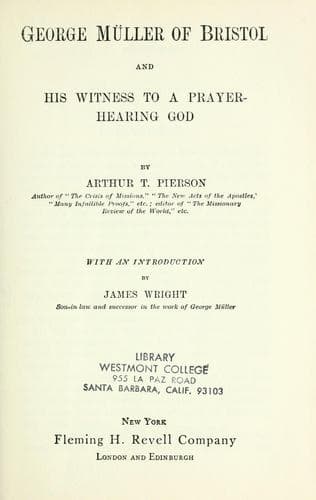
George Müller of Bristol, and His Witness to a Prayer-Hearing GodPierson, Arthur T. (Arthur Tappan)
Religion
George Müller of Bristol, and His Witness to a Prayer-Hearing God
Pierson, Arthur T. (Arthur Tappan)
Müller, George, 1805-1898; Orphanages -- Great Britain; Prayer
IT became a point of solemn consideration with me, whether I could
remain connected with the Society in the usual way. My chief objections
were these: 1. If I were sent out by the Society, it was more than
probable, yea, almost needful, if I were to leave England, that I should
labour on the Continent, as I was unfit to be sent to eastern countries
on account of my health, which would probably have suffered, both on
account of the climate, and of my having to learn other languages. Now,
if I _did_ go to the Continent, it was evident that without ordination I
could not have any extensive field of usefulness, as unordained
ministers are generally prevented from labouring freely there; but I
could not conscientiously submit to be ordained by unconverted men,
professing to have power to set me apart for the ministry, or to
communicate something to me for this work which they do not possess
themselves. Besides this, I had other objections to being connected with
_any_ state church or national religious establishment, which arose from
the increased light which I had obtained through the reception of this
truth, that _the word of God is our only standard, and the Holy Spirit
our only teacher._ For as I now began to compare what I knew of the
establishment in England and those on the Continent with this only true
standard, the word of God, I found that all establishments, even because
they are establishments, i.e., the world and the church mixed up
together, not only contain in them the principles which necessarily must
lead to departure from the word of God; but also, as long as they remain
establishments, entirely preclude the acting throughout according to the
Holy Scriptures.--Then again, if I were to stay in England, the Society
would not allow me to preach in any place indiscriminately, where the
Lord might open a door for me; and to the ordination of English bishops
I had still greater objections than to the ordination of a Prussian
Consistory.
2. I further had a conscientious objection against being led and
directed by _men_ in my missionary labours. As a servant of Christ, it
appeared to me I ought to be guided by the Spirit, and not by men, as to
time and place; and this I would say, with all deference to others, who
may be much more taught and much more spiritually minded than myself. A
servant of Christ has but one Master.
3. I had love for the Jews, and I had been enabled to give proofs of it;
yet I could not conscientiously say, as the committee would expect from
me, that I would spend the greater part of my time only among them. For
the scriptural plan seemed to me that, in coming to a place, I should
seek out the Jews, and commence my labour particularly among them; but
that, if they rejected the gospel, I should go to the nominal
Christians.--The more I weighed these points, the more it appeared to me
that I should be acting hypocritically, were I to suffer them to remain
in my mind, without making them known to the committee.
Public-domain text, read in full here on John Shaqi.
Reviews
Reviews
No reviews yet
Be the first to share your thoughts on this work.
Elsewhere in the archive
Join the Discussion
Join the discussion
Sign in to leave a comment or review.
Sign InorCreate an account