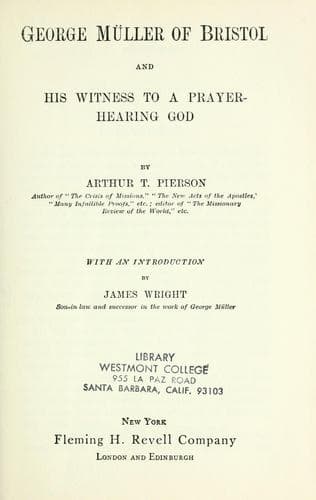
George Müller of Bristol, and His Witness to a Prayer-Hearing GodPierson, Arthur T. (Arthur Tappan)
Religion
George Müller of Bristol, and His Witness to a Prayer-Hearing God
Pierson, Arthur T. (Arthur Tappan)
Müller, George, 1805-1898; Orphanages -- Great Britain; Prayer
we had not received her, before being baptized, for she now saw that it
was only shame and the fear of man which had kept her back, and that the
Lord had now made her willing to be baptized. By this circumstance those
brethren who considered it scriptural that all ought to be baptized
before being received into fellowship, were confirmed in their views;
and as to brother Craik and me, it made us, at least, still more
question whether those brethren might not be right; and we felt,
therefore, that in such a state of mind we could not oppose them. The
one sister, therefore, who wished to be baptized was received into
fellowship, but the two others not. Our consciences were the less
affected by this because all, though not baptized, might take the Lord's
supper with us at Bethesda, though not be received into full fellowship;
and because at Gideon, where there were baptized and unbaptized
believers, they might even be received into full fellowship; for we had
not then clearly seen that there is _no scriptural_ distinction between
being in fellowship with individuals and breaking bread with them. Thus
matters stood for many months, i.e., believers were received to the
breaking of bread even at Bethesda, though not baptized, but they were
not received to all the privileges of fellowship.--In August of 1836 I
had a conversation with brother K. C. on, the subject of receiving the
unbaptized into communion, a subject about which, for years, my mind had
been more or less exercised. This brother put the matter thus before me:
either unbaptized believers come under the class of persons who walk
disorderly, and, in that case, we ought to withdraw from them (2 Thess.
iii. 6); or they do not walk disorderly. If a believer be walking
disorderly, we are not merely to withdraw from him at the Lord's table,
but our behaviour towards him ought to be decidedly different from what
it would be were he not walking disorderly, _on all occasions_ when we
may have intercourse with him, or come in any way into contact with him.
Now this is evidently not the case in the conduct of baptized believers
towards their unbaptized fellow believers. The Spirit does not suffer it
to be so, but He witnesses that their not having been baptized does not
necessarily imply that they are walking disorderly; and hence there may
be the most precious communion between baptized and unbaptized
believers. The Spirit does not suffer us to refuse fellowship with them
in prayer, in reading or searching the Scriptures, in social and
intimate intercourse, and in the Lord's work; and yet this ought to be
the case, were they walking disorderly.--This passage, 2 Thess. iii. 6,
to which brother E. C. referred, was the means of showing me the mind of
the Lord on the subject, which is, _that we ought to receive all whom
Christ has received_ (Rom. xv. 7), _irrespective of the measure of grace
or knowledge which they have attained unto._--Some time after this
Public-domain text, read in full here on John Shaqi.
Reviews
Reviews
No reviews yet
Be the first to share your thoughts on this work.
Elsewhere in the archive
Join the Discussion
Join the discussion
Sign in to leave a comment or review.
Sign InorCreate an account