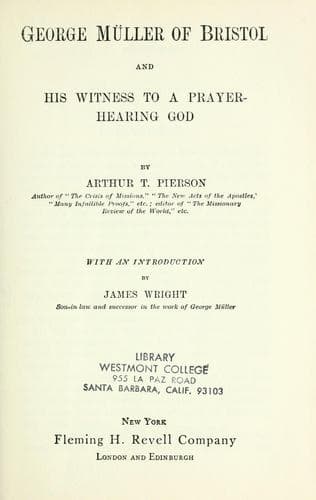
George Müller of Bristol, and His Witness to a Prayer-Hearing GodPierson, Arthur T. (Arthur Tappan)
Religion
George Müller of Bristol, and His Witness to a Prayer-Hearing God
Pierson, Arthur T. (Arthur Tappan)
Müller, George, 1805-1898; Orphanages -- Great Britain; Prayer
_Ans._ It cannot be expressly proved from Scripture whether such acts
were attended to at the meeting for the breaking of bread, or at any
other meeting; therefore this is a point on which, if different churches
differ, mutual forbearance ought to be exercised. The way in which such
matters have hitherto been managed amongst us has been by the church
coming together on a week-evening. Before we came to Bristol we had been
accustomed to this mode, and, finding nothing in Scripture against it,
we continued the practice. But, after prayer and more careful
consideration of this point, it has appeared well to us that such acts
should be attended to on the Lord's days, when the saints meet together
for the breaking of bread. We have been induced to make this alteration
by the following reasons:
(1) _This latter mode prevents matters from being delayed._ There not
being a sufficiency of matter for a meeting on purpose every week, it
has sometimes happened that what would better have been stated to the
church at once has been kept back from the body for some weeks. Now, it
is important that what concerns the whole church should be made known as
soon as possible to those who are in fellowship, that they may act
accordingly. Delay, moreover, seems inconsistent with the
pilgrim-character of the people of God.
(2) _More believers can be present on the Lord's days than can attend on
week-evenings._ The importance of this reason will appear from
considering how everything which concerns the church should be known to
_as many as possible._ For how can the saints pray for those who may
have to be excluded,--how can they sympathize in cases of peculiar
trial,--and how can they rejoice and give thanks on account of those who
may be received or restored, unless they are made acquainted with the
facts connected with such cases?
(3) _A testimony is thus given that all who break bread are church
members._ By attending to church acts in the meeting for breaking of
bread, we show that we _make no difference_ between receiving into
fellowship at the Lord's Supper, and into church membership, but that
the individual who is admitted to the Lord's table is therewith also
received to all the privileges, trials, and responsibilities of church
membership.
(4) There is a peculiar propriety in acts of reception, restoration, and
exclusion being attended to when the saints meet together for the
breaking of bread, as, in that ordinance especially, we show forth our
fellowship with each other.
Objections answered.
(1) This alteration has the appearance of changeableness.
_Reply._ Such an objection would apply to any case in which increased
light led to any improvement, and is, therefore, not to be regarded. It
would be an evil thing if there were any change respecting the
foundation truths of the Gospel; but the point in question is only a
matter of church order.
(2) More time may thus be required than it would be well to give to such
a purpose on the Lord's day.
Public-domain text, read in full here on John Shaqi.
Reviews
Reviews
No reviews yet
Be the first to share your thoughts on this work.
Elsewhere in the archive
Join the Discussion
Join the discussion
Sign in to leave a comment or review.
Sign InorCreate an account