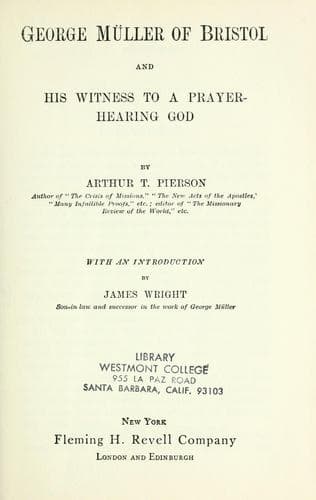
George Müller of Bristol, and His Witness to a Prayer-Hearing GodPierson, Arthur T. (Arthur Tappan)
Religion
George Müller of Bristol, and His Witness to a Prayer-Hearing God
Pierson, Arthur T. (Arthur Tappan)
Müller, George, 1805-1898; Orphanages -- Great Britain; Prayer
That the disciples of Jesus should meet together on the first day of the
week for the breaking of bread, and that that should be their principal
meeting, and that those, whether one or several, who are truly gifted by
the Holy Spirit for service, be it for exhortation, or teaching, or
rule, etc., are responsible to the Lord for the exercise of their
gifts--these are to me no matters of uncertainty, but points on which my
soul, by grace, is established, through the revealed will of God.
FORMALISM.
I have often remarked the injurious effects of doing things because
others did them, or because it was the custom, or because they were
persuaded into acts of _outward_ self-denial, or giving up things whilst
the heart did not go along with it, and whilst the _outward act_ WAS NOT
_the result of the inward powerful working of the Holy Ghost, and the
happy entering into our fellowship with the Father and with the Son._
Everything that is a mere form, a mere habit and custom in divine
things, is to be dreaded exceedingly: _life, power, reality,_ this is
what we have to aim after. Things should not result from without, but
from within. The sort of clothes I wear, the kind of house I live in,
the quality of the furniture I use, all such like things should not
result from other persons' doing so and so, or because it is customary
among those brethren with whom I associate to live in such and such a
simple, inexpensive self-denying way; but whatever be done in these
things, in the way of giving up, or self-denial, or deadness to the
world, should result from the joy we have in God, from the knowledge of
our being the children of God, from the entering into the preciousness
of our future inheritance, etc. Far better that for the time being we
stand still, and do not take the steps which we see others take, than
that it is merely the force of example that leads us to do a thing, and
afterwards it be regretted. Not that I mean in the least by this to
imply we should continue to live in luxury, self-indulgence, and the
like, whilst others are in great need; but we should begin the thing in
a right way, i.e., aim after the right state of heart; begin _inwardly_
instead of _outwardly._ If otherwise, it will not last. We shall look
back, or even get into a worse state than we were before. But oh, how
different if joy in God leads us to any little act of self-denial! How
gladly do we do it then! How great an honour then do we esteem it to be!
How much does the heart then long to be able to do more for Him who has
done so much for us! We are far then from looking down in proud
self-complacency upon those who do not go as far as we do, but rather
pray to the Lord that He would be pleased to help our dear brethren and
sisters forward who may seem to us weak in any particular point; and we
also are conscious to ourselves that if we have a little more light or
strength with reference to one point, other brethren may have more light
or grace in other respects.
Public-domain text, read in full here on John Shaqi.
Reviews
Reviews
No reviews yet
Be the first to share your thoughts on this work.
Elsewhere in the archive
Join the Discussion
Join the discussion
Sign in to leave a comment or review.
Sign InorCreate an account