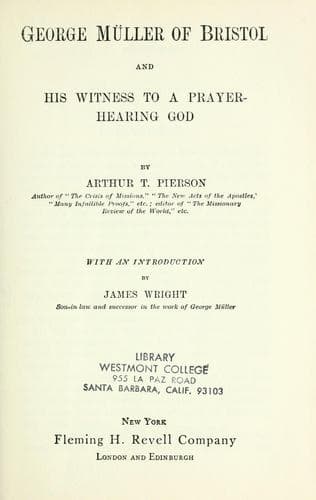
George Müller of Bristol, and His Witness to a Prayer-Hearing GodPierson, Arthur T. (Arthur Tappan)
Religion
George Müller of Bristol, and His Witness to a Prayer-Hearing God
Pierson, Arthur T. (Arthur Tappan)
Müller, George, 1805-1898; Orphanages -- Great Britain; Prayer
This expression, found in Paul's second letter to Timothy, is a very
peculiar one ([Transcriber's Note: Greek source text for the English
phrase quoted in the paragraph immediately above appears here]). It
seems to be nearly equivalent to the Latin phrase _recte viam secare--to
cut a straight road_--and to hint that the true workman of God is like
the civil engineer to whom it is given to construct a direct road to a
certain point. The hearer's heart and conscience is the objective point,
and the aim of the preacher should be, so to use God's truth as to reach
most directly and effectively the needs of the hearer. He is to avoid
all circuitous routes, all evasions, all deceptive apologies and by-ways
of argument, and seek by God's help to find the shortest, straightest,
quickest road to the convictions and resolutions of those to whom he
speaks. And if the road-builder, before he takes any other step, first
carefully _surveys his territory and lays out his route,_ how much more
should the preacher first study the needs of his hearers and the best
ways of successfully dealing with them, and then with even more
carefulness and prayerfulness study the adaptation of the word of God
and the gospel message to meet those wants.
Early in the year 1833, letters from missionaries in Baghdad urged
Messrs. Muller and Craik to join them in labours in that distant field,
accompanying the invitation with drafts for two hundred pounds for costs
of travel. Two weeks of prayerful inquiry as to the mind of the Lord,
however, led them to a clear decision _not_ to go--a choice never
regretted, and which is here recorded only as part of a complete
biography, and as illustrating the manner in which each new call for
service was weighed and decided.
We now reach another stage of Mr. Muller's entrance upon his complete
life-work. In February, 1832, he had begun to read the biography of A.
H. Francke, the founder of the Orphan Houses of Halle. As that life and
work were undoubtedly used of God to make him a like instrument in a
kindred service, and to mould even the methods of his philanthropy, a
brief sketch of Francke's career may be helpful.
August H. Francke was Muller's fellow countryman. About 1696, at Halle
in Prussia, he had commenced the largest enterprise for poor children
then existing in the world. He trusted in God, and He whom he trusted
did not fail him, but helped him throughout abundantly.
The institutions, which resembled rather a large street than a building,
were erected, and in them about two thousand orphan children were
housed, fed, clad, and taught. For about thirty years all went on under
Francke's own eyes, until 1727, when it pleased the Master to call the
servant up higher; and after his departure his like-minded son-in-law
became the director. Two hundred years have passed, and these Orphan
Houses are still in existence, serving their noble purpose.
Public-domain text, read in full here on John Shaqi.
Reviews
Reviews
No reviews yet
Be the first to share your thoughts on this work.
Elsewhere in the archive
Join the Discussion
Join the discussion
Sign in to leave a comment or review.
Sign InorCreate an account