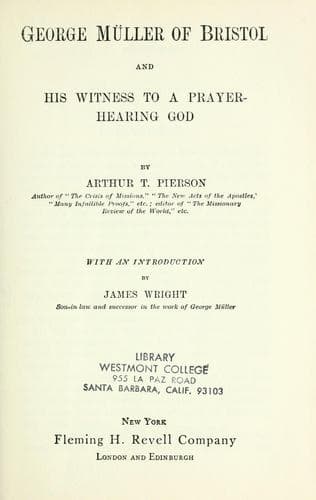
George Müller of Bristol, and His Witness to a Prayer-Hearing GodPierson, Arthur T. (Arthur Tappan)
Religion
George Müller of Bristol, and His Witness to a Prayer-Hearing God
Pierson, Arthur T. (Arthur Tappan)
Müller, George, 1805-1898; Orphanages -- Great Britain; Prayer
Mr. Muller was never actually reckless of his bodily health. His habits
were temperate and wholesome, but no man could be so completely wrapped
up in his Master's will and work without being correspondingly forgetful
of his physical frame. There are not a few, even among God's saints,
whose bodily weaknesses and distresses so engross them that their sole
business seems to be to nurse the body, keep it alive and promote its
comfort. As Dr. Watts would have said, this is living "at a poor dying
rate."
When the year 1838 opened, the weakness and distress in the head still
afflicted Mr. Muller. The symptoms were as bad as ever, and it
particularly tried him that they were attended by a tendency to
irritability of temper, and even by a sort of satanic feeling wholly
foreign to him at other times. He was often reminded that he was by
nature a child of wrath even as others, and that, as a child of God, he
could stand against the wiles of the devil only by putting on the whole
armour of God. The pavilion of God is the saint's place of rest; the
panoply of God is his coat of mail. Grace does not at once remove or
overcome all tendencies to evil, but, if not _eradicated,_ they are
_counteracted_ by the Spirit's wondrous working. Peter found that so
long as his eye was on His Master he could walk on the water. There is
always a tendency to sink, and a holy walk with God, that defies the
tendency downward, is a divine art that can neither be learned nor
practised except so long as we keep 'looking unto Jesus': that look of
faith counteracts the natural tendency to sink, so long as it holds the
soul closely to Him. This man of God felt his risk, and, sore as this
trial was to him, he prayed not so much for its removal as that he might
be kept from any open dishonour to the name of the Lord, beseeching God
that he might rather die than ever bring on Him reproach.
Mr. Muller's journal is not only a record of his outer life of
consecrated labour and its expansion, but it is a mirror of his inner
life and its growth. It is an encouragement to all other saints to find
that this growth was, like their own, in spite of many and formidable
hindrances, over which only grace could triumph. Side by side with
glimpses of habitual conscientiousness and joy in God, we have
revelations of times of coldness and despondency. It is a wholesome
lesson in holy living that we find this man setting himself to the
deliberate task of _cultivating obedience and gratitude;_ by the culture
of obedience growing in knowledge and strength, and by the culture of
gratitude growing in thankfulness and love. Weakness and coldness are
not hopeless states: they have their divine remedies which strengthen
and warm the whole being.
Public-domain text, read in full here on John Shaqi.
Reviews
Reviews
No reviews yet
Be the first to share your thoughts on this work.
Elsewhere in the archive
Join the Discussion
Join the discussion
Sign in to leave a comment or review.
Sign InorCreate an account