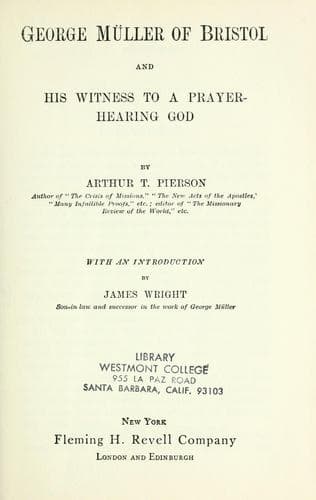
George Müller of Bristol, and His Witness to a Prayer-Hearing GodPierson, Arthur T. (Arthur Tappan)
Religion
George Müller of Bristol, and His Witness to a Prayer-Hearing God
Pierson, Arthur T. (Arthur Tappan)
Müller, George, 1805-1898; Orphanages -- Great Britain; Prayer
HABIT both _shows_ and _makes_ the man, for it is at once historic and
prophetic, the mirror of the man as he is and the mould of the man as he
is to be. At this point, therefore, special attention may properly be
given to the two marked habits which had principally to do with the man
we are studying.
Early in the year 1838, he began reading that third biography which,
with those of Francke and John Newton, had such a singular influence on
his own life--Philip's Life of George Whitefield. The life-story of the
orphan's friend had given the primary impulse to his work; the
life-story of the converted blasphemer had suggested his narrative of
the Lord's dealings; and now the life-story of the great evangelist was
blessed of God to shape his general character and give new power to his
preaching and his wider ministry to souls. These three biographies
together probably affected the whole inward and outward life of George
Muller more than any other volumes but the Book of God, and they were
wisely fitted of God to co-work toward such a blessed result. The
example of Francke incited to faith in prayer and to a work whose sole
dependence was on God. Newton's witness to grace led to a testimony to
the same sovereign love and mercy as seen in his own case. Whitefield's
experience inspired to greater fidelity and earnestness in preaching the
Word, and to greater confidence in the power of the anointing Spirit.
Particularly was this impression deeply made on Mr. Muller's mind and
heart: that Whitefield's unparalleled success in evangelistic labours
was plainly traceable to two causes and could not be separated from them
as direct effects; namely, his _unusual prayerfulness, and his habit of
reading the Bible on his knees._
The great evangelist of the last century had learned that first lesson
in service, his own utter nothingness and helplessness: that he was
nothing, and could do nothing, without God. He could neither understand
the Word for himself, nor translate it into his own life, nor apply it
to others with power, unless the Holy Spirit became to him both
_insight_ and _unction._ Hence his success; he was filled with the
Spirit: and this alone accounts both for the quality and the quantity of
his labours. He died in 1770, in the fifty-sixth year of his age, having
preached his first sermon in Gloucester in 1736. During this thirty-four
years his labours had been both unceasing and untiring. While on his
journeyings in America, he preached one hundred and seventy-five times
in seventy-five days, besides travelling, in the slow vehicles of those
days, upwards of eight hundred miles. When health declined, and he was
put on 'short allowance,' even that was _one sermon each week-day and
three on Sunday._ There was about his preaching, moreover, a nameless
charm which held thirty thousand hearers half-breathless on Boston
Common and made tears pour down the sooty faces of the colliers at
Kingswood.
Public-domain text, read in full here on John Shaqi.
Reviews
Reviews
No reviews yet
Be the first to share your thoughts on this work.
Elsewhere in the archive
Join the Discussion
Join the discussion
Sign in to leave a comment or review.
Sign InorCreate an account