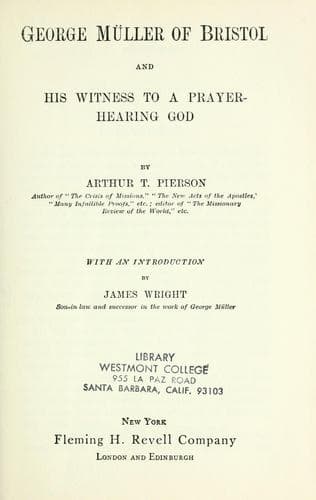
George Müller of Bristol, and His Witness to a Prayer-Hearing GodPierson, Arthur T. (Arthur Tappan)
Religion
George Müller of Bristol, and His Witness to a Prayer-Hearing God
Pierson, Arthur T. (Arthur Tappan)
Müller, George, 1805-1898; Orphanages -- Great Britain; Prayer
It was habits of life such as these, and not impulsive feelings and
transient frames, that made this man of God what he was and strengthened
him to lift up his hands in God's name, and follow hard after Him and in
Him rejoice.* Even his sore affliction, seen in the light of such
prayer--prayer itself illuminated by the word of God--became radiant;
and his soul was brought into that state where he so delighted in the
will of God as to be able from his heart to say that he would not have
his disease removed until through it God had wrought the blessing it was
meant to convey. And when his acquiescence in the will of God had become
thus complete he instinctively felt that he would speedily be restored
to health.
* Psalm lxiii. 4, 8, 11.
Subsequently, in reading Proverbs iii. 5-12, he was struck with the
words, "Neither be _weary_ of His correction." He felt that, though he
had not been permitted to "despise the chastening of the Lord," he had
at times been somewhat "weary of His correction," and he lifted up the
prayer that he might so patiently bear it as neither to faint nor be
weary under it, till its full purpose was wrought.
Frequent were the instances of the habit of translating promises into
prayers, immediately applying the truth thus unveiled to him. For
example, after prolonged meditation over the first verse of Psalm lxv,
_"O Thou that hearest prayer,"_ he at once asked and recorded certain
definite petitions. This writing down specific requests for permanent
reference has a blessed influence upon the prayer habit. It assures
practical and exact form for our supplications, impresses the mind and
memory with what is thus asked of God, and leads naturally to the record
of the answers when given, so that we accumulate evidences in our own
experience that God is to us personally a prayer-hearing God, whereby
unbelief is rebuked and importunity encouraged.
On this occasion eight specific requests are put on record, together
with the solemn conviction that, having asked in conformity with the
word and will of God, and in the name of Jesus, he has confidence in Him
that He heareth and that he has the petitions thus asked of Him.* He
writes:
* 1 John v. 13.
"I believe _He has heard me._ I believe He will make it _manifest_ in
His own good time _that He has heard me;_ and I have recorded these my
petitions this fourteenth day of January, 1838, that when God has
answered them He may get, through this, glory to His name."
The thoughtful reader must see in all this a man of weak faith, feeding
and nourishing his trust in God that his faith may grow strong. He uses
the promise of a prayer-hearing God as a staff to stay his conscious
feebleness, that he may lean hard upon the strong Word which cannot
fail. He records the day when he thus takes this staff in hand, and the
very petitions which are the burdens which he seeks to lay on God, so
that his act of committal may be the more complete and final. Could God
ever dishonour such trust?
Public-domain text, read in full here on John Shaqi.
Reviews
Reviews
No reviews yet
Be the first to share your thoughts on this work.
Elsewhere in the archive
Join the Discussion
Join the discussion
Sign in to leave a comment or review.
Sign InorCreate an account