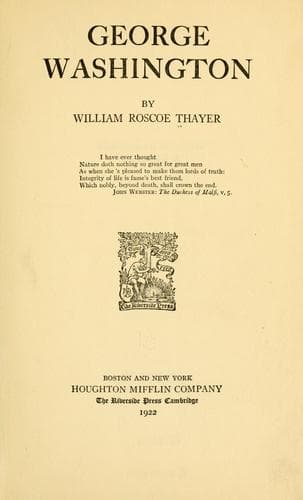
Presidents -- United States -- Biography; Washington, George, 1732-1799
He believed, however, that the President must guard his office from
the free-and-easy want of decorum which some of his countrymen
regarded as the stamp of democracy. At his receptions he wore a black
velvet suit with gold buckles at the knee and on his shoes, and yellow
gloves, and profusely powdered hair carried in a silk bag behind. In
one hand he held a cocked hat with an ostrich plume; on his left thigh
he wore a sword in a white scabbard of polished leather. He shook
hands with no one; but acknowledged the courtesy of his visitors by
a very formal bow. When he drove, it was in a coach with four or six
handsome horses and outriders and lackeys dressed in resplendent
livery.
After his inauguration he spoke his address to the Congress, and
several days later members of the House and of the Senate called on
him at his residence and made formal replies to his Inaugural Address.
After a few weeks, experience led him to modify somewhat his daily
schedule. He found that unless it was checked, the insatiate public
would consume all his time. Every Tuesday afternoon, between three and
four o'clock, he had a public reception which any one might attend.
Likewise, on Friday afternoons, Mrs. Washington had receptions of her
own. The President accepted no invitations to dinner, but at his own
table there was an unending succession of invited guests, except on
Sunday, which he observed privately. Interviews with the President
could be had at any time that suited his convenience. Thus did he
arrange to transact his regular or his private business.
Inevitably, some of the public objected to his rules and pretended to
see very strong monarchical leanings in them. But the country took
them as he intended, and there can be no doubt that it felt the
benefit of his promoting the dignity of his office. Equally beneficial
was his rule of not appointing to any office any man merely because he
was the President's friend. Washington knew that such a consideration
would give the candidate an unfair advantage. He knew further that
office-holders who could screen themselves behind the plea that they
were the President's friends might be very embarrassing to him. As
office-seekers became, with the development of the Republic, among
the most pernicious of its evils and of its infamies, we can but feel
grateful that so far as in him lay Washington tried to keep them
within bounds.
Public-domain text, read in full here on John Shaqi.
Reviews
Reviews
No reviews yet
Be the first to share your thoughts on this work.
Elsewhere in the archive
Join the Discussion
Join the discussion
Sign in to leave a comment or review.
Sign InorCreate an account