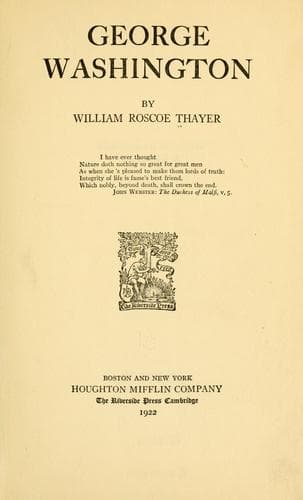
Presidents -- United States -- Biography; Washington, George, 1732-1799
a candidate for a second term. He told his intention to a few
intimates--from them it spread to many others. His best friends were
amazed. They foresaw great trials for the Nation and a possible
revolution. Hamilton tried to move him by every sort of appeal.
Jefferson also was almost boisterous in denouncing the very idea. He
impressed upon him the importance of his continuing at that crisis. He
had not been President long enough to establish precedents for the new
Nation. There were many volatile incidents which, if treated with less
judgment than his, might do grievous harm. One wonders how sincere all
the entreaties to Washington were, but one cannot doubt that the great
majority of the country was perfectly sincere in wishing to have him
continue; for it had sunk deep into the hearts of Americans that
Washington was himself a party, a policy, an ideal above all the rest.
And when the election was held in the autumn of 1792, he was reëlected
by the equivalent of a unanimous vote.
CHAPTER X
THE JAY TREATY
There is no doubt that Washington in his Olympian quiet took a real
satisfaction in his election. On January 20, 1793, he wrote to
Governor Henry Lee of Virginia:
A mind must be insensible indeed not to be gratefully impressed by
so distinguished and honorable a testimony of public approbation
and confidence; and as I suffered my name to be contemplated on
this occasion, it is more than probable that I should, for a
moment, have experienced chagrin, if my reëlection had not been
by a pretty respectable vote. But to say I feel pleasure from the
prospect of commencing another term of duty would be a departure
from the truth,--for, however it might savor of affectation in
the opinion of the world (who, by the by, can only guess at my
sentiments, as it never has been troubled with them), my
particular and confidential friends well know, that it was after a
long and painful conflict in my own breast, that I was withheld,
(by considerations which are not necessary to be mentioned), from
requesting in time, that no vote might be thrown away upon me, it
being my fixed determination to return to the walks of private
life at the end of my term.[1]
[Footnote 1: Ford, XII, 256.]
Public-domain text, read in full here on John Shaqi.
Reviews
Reviews
No reviews yet
Be the first to share your thoughts on this work.
Elsewhere in the archive
Join the Discussion
Join the discussion
Sign in to leave a comment or review.
Sign InorCreate an account