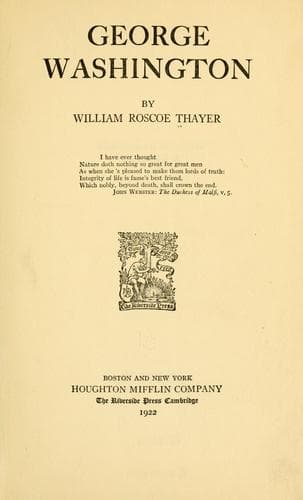
Presidents -- United States -- Biography; Washington, George, 1732-1799
My primary objects, to which I have steadily adhered, have been to
preserve the country in peace, if I can, and to be prepared for
war if I cannot, to effect the first, upon terms consistent with
the respect which is due to ourselves, and with honor, justice and
good faith to all the world.
Mr. Jay (and not Mr. Jefferson) as has been suggested to you,
embarked as envoy extraordinary for England about the middle of
May. If he succeed, well; if he does not, why, knowing the worst,
we must take measures accordingly.[1]
[Footnote 1: Ford, XII, 436. Mount Vernon, June 25, 1794.]
Jay reached London early in June, 1794, and labored over the treaty
with the British negotiators during the summer and autumn, started for
home before Christmas, and put the finished document in Washington's
hands in March. From the moment of his going enemies of all kinds
talked bitterly against him. The result must be a foregone conclusion,
since John Jay was regarded as the chief Anglo-maniac in America after
Hamilton. They therefore condemned in advance any treaty he might
agree to. But their criticism went deeper than mere hatred of him: it
sprang from an inveterate hatred of England, which dated from before
the Revolution. Since the Treaty of 1783 the English seemed to act
deliberately with studied truculence, as if the Americans would not
and could not retaliate. They were believed to be instigating the
Indians to continuous underhand war. They had reached that dangerous
stage of truculence, when they did not think it mattered whether
they spoke with common diplomatic reticence. Lord Dorchester, the
Governor-General of Canada, and to-day better known as Sir Guy
Carleton, his name before they made him a peer, addressed a gathering
of Indian chiefs at Quebec on the assumption that war would come in a
few weeks. President Washington kept steady watch of every symptom,
and he knew that it would not require a large spark to kindle a
conflagration. "My objects are, to prevent a war," he wrote to Edmund
Randolph, on April 15, 1794, "if justice can be obtained by fair and
strong representations (to be made by a special envoy) of the injuries
which this country has sustained from Great Britain in various ways,
to put it into a complete state of military defence, and to provide
_eventually_ for such measures as seem to be now pending in
Congress for execution, if negotiations in a reasonable time proves
unsuccessful."[1]
[Footnote 1: Ford, XIII, 4-9.]
The year 1794 marked the sleepless anxiety of the Silent President.
Day and night his thoughts were in London, with Jay. He said little;
he had few letters from Jay--it then required from eight to ten weeks
for the mail clippers to make a voyage across the Atlantic. Opposition
to the general idea of such a treaty as the mass of Republicans and
Anti-Federalists supposed Washington hoped to secure, grew week by
week. The Silent Man heard the cavil and said nothing.
Public-domain text, read in full here on John Shaqi.
Reviews
Reviews
No reviews yet
Be the first to share your thoughts on this work.
Elsewhere in the archive
Join the Discussion
Join the discussion
Sign in to leave a comment or review.
Sign InorCreate an account