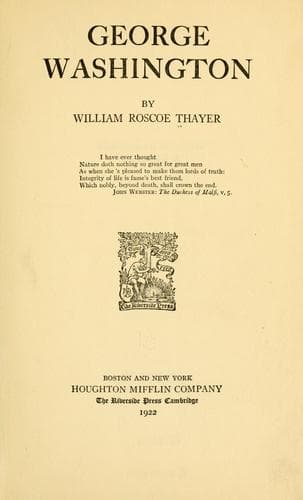
Presidents -- United States -- Biography; Washington, George, 1732-1799
We need to note two or three events before Washington's term ended
because they were thoroughly characteristic. First of these was the
Whiskey Insurrection in western Pennsylvania. The inhabitants first
grew surly, then broke out in insurrection on account of the Excise
Law. They found it cheaper to convert their corn and grain into
whiskey, which could be more easily transported, but the Government
insisted that the Excise Law, being a law, should be obeyed. The
malcontents held a great mass meeting on Braddock's Field, denounced
the law and declared that they would not obey it. Washington issued a
proclamation calling upon the people to resume their peaceable life.
He called also on the Governors of Pennsylvania, Maryland, New
Jersey, and Virginia for troops, which they furnished. His right-hand
lieutenant was Alexander Hamilton, who felt quite as keenly as he
did himself the importance of putting down such an insurrection.
Washington knew that if any body of the people were allowed unpunished
to rise and disobey any law which pinched or irritated them, all law
and order would very soon go by the board. His action was one of the
great examples in government which he set the people of the United
States. He showed that we must never parley or haggle with sedition,
treason, or lawlessness, but must strike a blow that cannot be
parried, and at once. The Whiskey Insurrectionists may have imagined
that they were too remote to be reached in their western wilderness,
but he taught them a most salutary lesson that, as they were in the
Union, the power of the Union could and would reach them.
Public-domain text, read in full here on John Shaqi.
Reviews
Reviews
No reviews yet
Be the first to share your thoughts on this work.
Elsewhere in the archive
Join the Discussion
Join the discussion
Sign in to leave a comment or review.
Sign InorCreate an account