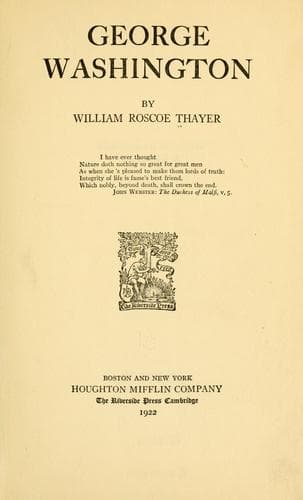
Presidents -- United States -- Biography; Washington, George, 1732-1799
In conversation his face had not much variety of expression. A
look of thoughtfulness was given by the compression of the mouth
and the indentations of the brow (suggesting an habitual conflict
with, and mastery over, passion), which did not seem so much
to disdain a sympathy with trivialities as to be incapable of
denoting them. Nor had his voice, so far as I could discover in
our quiet talk, much change or richness of intonation, but he
always spoke with earnestness, and his eyes (glorious conductors
of the light within) burned with a steady fire which no one could
mistake for mere affability; they were one grand expression of the
well-known line: "I am a man, and interested in all that concerns
humanity." In one hour and a half's conversation he touched on
every topic that I brought before him with an even current of good
sense, if he embellished it with little wit or verbal elegance. He
spoke like a man who had felt as much as he had reflected, more
than he had spoken; like one who had looked upon society rather in
the mass than in detail, and who regarded the happiness of America
but as the first link in a series of universal victories; for his
full faith in the power of those results of civil liberty which
he saw all around him led him to foresee that it would erelong,
prevail in other countries and that the social millennium of
Europe would usher in the political. When I mentioned to him the
difference I perceived between the inhabitants of New England
and of the Southern States, he remarked: "I esteem those people
greatly, they are the stamina of the Union and its greatest
benefactors. They are continually spreading themselves too, to
settle and enlighten less favored quarters. Dr. Franklin is a New
Englander." When I remarked that his observations were flattering
to my country, he replied, with great good humor, "Yes, yes,
Mr. Bernard, but I consider your country the cradle of free
principles, not their armchair. Liberty in England is a sort of
idol; people are bred up in the belief and love of it, but see
little of its doings. They walk about freely, but then it is
between high walls; and the error of its government was in
supposing that after a portion of their subjects had crossed the
sea to live upon a common, they would permit their friends at home
to build up those walls about them."[1]
[Footnote 1: Lodge, II, 338, 339.]
Public-domain text, read in full here on John Shaqi.
Reviews
Reviews
No reviews yet
Be the first to share your thoughts on this work.
Elsewhere in the archive
Join the Discussion
Join the discussion
Sign in to leave a comment or review.
Sign InorCreate an account