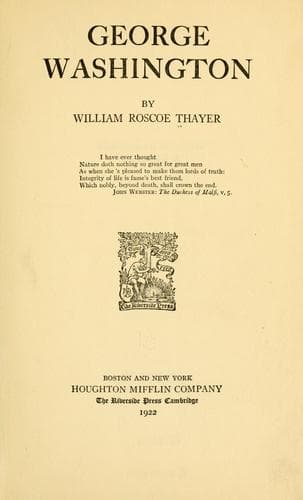
Presidents -- United States -- Biography; Washington, George, 1732-1799
Washington, George, ancestry, 1;
birth, 1, 2;
childhood and education, 2;
errors of Weems's biography, 2, 3;
absurdity of the cherry-tree story, 2;
Sparks's ill-advised editing of letters of, 3, 4;
and Mather's _Young Man's Companion_, 4;
surveys Fairfax estate, 5;
results of his experience as surveyor, 5;
his journals, 6, 7, 8, 10, 11, 37, 38, 39, 169;
his disposition, 7, 8;
attention, to dress, 8, 9;
declines appointment as midshipman, 9;
commissioned major of militia, 9;
visit to Barbados, 9, 10;
as manager of Mt. Vernon, 12;
sent by Dinwiddie on mission of warning to French, 14;
and the "Half-King," 14, 15;
second in command of Fry's expedition, 15_ff_.;
was he a "silent man"? 17, 18;
a volunteer on Braddock's expedition, 20, 21;
his account of the defeat, 22, 23;
his conduct in the battle, 23;
moral results of his campaigning, 25, 26;
his early love-affairs, 30, 31;
and Mary Philipse, 31, 32;
his physique, 32, 69;
a sound thinker, 33, 70;
inherits Mt. Vernon, 33;
courts and marries Mrs. Custis, 33, 34, 35;
in House of Burgesses, 36, 37;
as an agriculturist, 37 _ff_.;
his views on slave labor, 38, and slavery, 38, 39, 238;
relations with his slaves, 38, 237-239;
and his step-children, 40-42;
by nature a man of business, 42, 43;
improves his education, 43, 44;
as a country gentleman, 44_ff_.;
the hospitality of Mt. Vernon, 45.
His view of the Stamp Act and other measures of the British
Government, 51, 52;
a loyal American, 52;
signs Mason's plan of association, 53;
no doubt as to his position, 55, 56, 57;
offers to raise 1000 men at his own expense, 57;
in first Continental Congress, 59, 60;
his mind made up, 62, 63;
chosen Commander-in-chief of Continental forces, 64, 65;
takes command at Cambridge, 65, 69;
plans to blockade Boston, 69;
jealousy among his officers, 70, 71;
and military amateurs, 71;
opposes expedition against Canada, 71;
whips his army into shape, 72;
appeals for supply of powder, 72;
forces evacuation of Boston, 73;
moves troops to New York, 74;
before Congress in Phila., 74, 75;
his opinion of Congress, 75;
retreats from Long Island after Sullivan's defeat, 77, 78;
inadequacy of his resources, 78;
moves army to Heights of Harlem, 80;
on the evils of American military system, 80, 81;
his troops not discouraged by his frankness, 82;
on the difficulty of his position, 82, 83;
his movements after battle of White Plains, 83 _ff_.;
crosses the Delaware and wins battles of Trenton and Princeton, 86;
a Necessary Man, 87;
his fearlessness of danger, 87, 88;
his movements impeded by dependence on Congress, 90, 118, 119;
his miscellaneous labors, 95 _ff_.;
his circular on looting by his troops, 97, 98;
on the maltreatment of American prisoners, 98;
takes Lafayette on his staff, 99;
chooses Valley Forge for winter quarters, 100;
describes its horrors, 101-103;
enters Phila.
Public-domain text, read in full here on John Shaqi.
Reviews
Reviews
No reviews yet
Be the first to share your thoughts on this work.
Elsewhere in the archive
Join the Discussion
Join the discussion
Sign in to leave a comment or review.
Sign InorCreate an account