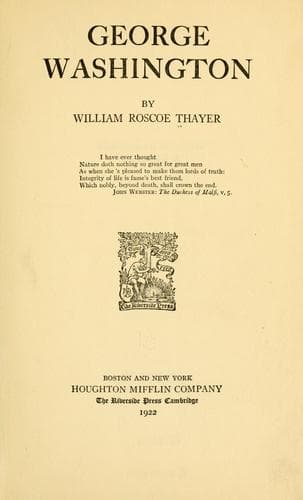
Presidents -- United States -- Biography; Washington, George, 1732-1799
At length, my dear Marquis, I am become a private citizen on the
banks of the Potomac; and under the shadow of my own vine and my
own fig-tree, free from the bustle of a camp, and the busy
scenes of public life, I am solacing myself with those tranquil
enjoyments, of which the soldier, who is ever in pursuit of fame,
the statesman, whose watchful days and sleepless nights are spent
in devising schemes to promote the welfare of his own, perhaps the
ruin of other countries, as if this globe was insufficient for us
all, and the courtier, who is always watching the countenance of
his prince, in hopes of catching a gracious smile, can have
very little conception. I have not only retired from all public
employments, but I am retiring within myself, and shall be able to
view the solitary walk, and tread the paths of private life, with
heartful satisfaction. Envious of none, I am determined to be
pleased with all; and this, my dear friend, being the order of my
march, I will move gently down the stream of life, until I sleep
with my fathers.[1]
[Footnote 1: Hapgood, 287.]
In September, 1784, he made a journey on horseback, with a pack-train
to carry his tents and food, into the Northwestern country, which had
especially interested him since the early days when Fort Duquesne was
the goal of his wandering. He observed very closely and his mind was
filled with large imaginings of what the future would see in the
development of the Northwest. Since his youth he had never lost
the conviction that an empire would spring up there; only make the
waterways easy and safe and he felt sure that a very large commerce
would result and with it the extension of civilization. In a memorial
to the legislature he urged that Virginia was the best placed
geographically of all the States to undertake the work of establishing
connection with the States of the Northwest, and he suggested various
details which, when acted upon later, proved to be, as Sparks
remarked, "the first suggestion of the great system of internal
improvements which has since been pursued in the United States."
On returning to Mount Vernon, he entertained Lafayette for the last
time before he sailed for France. After he had gone, Washington wrote
him this letter in which appears the affection of a friend and the
reverie of an old man looking somewhat wistfully towards sunset, "and
after that the dark":
Public-domain text, read in full here on John Shaqi.
Reviews
Reviews
No reviews yet
Be the first to share your thoughts on this work.
Elsewhere in the archive
Join the Discussion
Join the discussion
Sign in to leave a comment or review.
Sign InorCreate an account