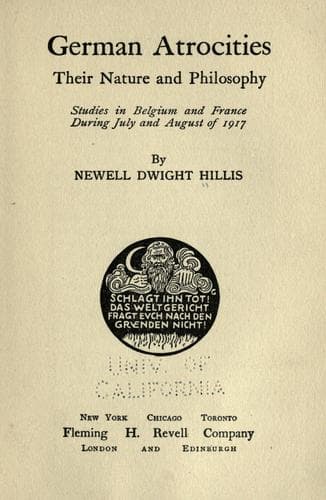
German Atrocities: Their Nature and PhilosophyHillis, Newell Dwight
History
German Atrocities: Their Nature and Philosophy
Hillis, Newell Dwight
Pangermanism; World War, 1914-1918; World War, 1914-1918 -- Atrocities
K. Bartel--on crimes he had witnessed--as they were committed by his
own officers and fellow privates. "Our men have shrunk morally below
zero. Oct. 7th."
Yager Otto Clepp, August 22nd, in Liège makes this entry: "Two of our
regiments shot at each other; nine dead and fifty wounded. Reason for
mistake not yet ascertained."
There is a striking commentary on the German War Staff's Commission's
statement that they shot the old men and women in Liège because of an
attack by the people. This German officer's entry illustrates what
doubtless happened many times. When the Germans were drunk, terrified
by the sense of their own crimes and expecting the people to resist the
cruelties, one German company turned and fired upon another.
H. W. Heller. August 6th. "Friday at 8:30 came the news that the
English had landed in Belgium. We smashed everything immediately. One
sees only burning houses and heaps of dead people and dead horses every
three steps."
Fritz Holman writes: "We are never thirsty here in France. We drink
five and six bottles of champagne a day, and as to under linen, we
simply loot a house and change. God only knows what will happen unto us
later on."
Stephen Luther's diary. "Monday the 10th. Marching via Laden. Villages
friendly disposed, one of them bombarded in error. Misunderstandings
occurred because our officers understand no French. There was terrible
destruction; in a farmhouse saw a woman who had been completely
stripped and who lay on burnt beams. How savage! Terrible conditions
in the destroyed houses." "August 24, 1914. In Ermiton we took about a
thousand prisoners. At least five hundred were shot."
* * * * *
Let this series be closed by a few trenchant words from two of
Germany's most famous poets, characterizing the Prussian nature that
to-day controls all Germany (and neighbour Austria besides). The great
Goethe was from Weimar, but the satiric Heine, from Düsseldorf--a
Prussian, born.
PRUSSIANISM
"The Prussians are cruel by nature; civilization will make them
ferocious."--_Goethe._
"The Prussians ... Nature made them stupid, science has made them
wicked."--_Heinrich Heine._
"Christianity has to a certain extent softened this brutal, belligerent
ardour of the Teutons, but it has not been able to destroy it; and
when the Cross--the talisman that fetters it--shall be broken, then
the ferocity of the old-time fighters, the frenzied exultation of the
Berserkers, whose praises are still sung by the poets of the North,
will again burst forth. Then--and alas! this day will surely come--the
old war gods will arise from their legendary tombs and wipe the dust
of ages from their eyes; Thor will arise with his gigantic hammer and
demolish the Gothic Cathedral."--_Heinrich Heine._
* * * * *
Public-domain text, read in full here on John Shaqi.
Reviews
Reviews
No reviews yet
Be the first to share your thoughts on this work.
Elsewhere in the archive
Join the Discussion
Join the discussion
Sign in to leave a comment or review.
Sign InorCreate an account