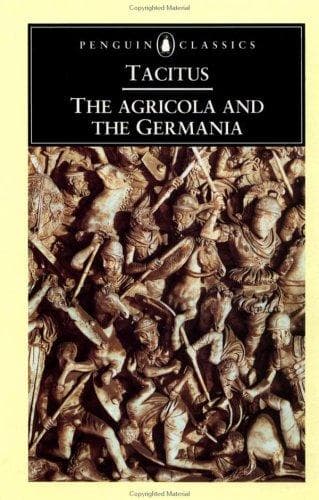
Agricola, Gnaeus Julius, 40-93; Germanic peoples -- Early works to 1800; Statesmen -- Rome -- Biography -- Early works to 1800
_Persuasione_. See the same use of the word, His. 5, 5: eademque de
infernis persuasio.
_In--periculis_. The same sentiment is expressed by Caesar (B.G. 3, 19).
_Ferociae_. In a good sense, courage, cf. 31: virtus ac ferocia.
_Praeferunt_==prae se ferunt, i.e. _exhibit_.
_Ut quos. Ut qui_, like _qui_ alone, is followed by the subj. to express
a reason for what precedes. It may be rendered by _because_ or _since_
with the demonstrative. So _quippe cui placuisset_, 18. Cf. Z. 565 and H.
519, 3.
_Gallos floruisse_. Cf. G. 28.
_Otio_. Opposed to _bellis, peace.--Amissa virtute_. Abl. abs. denoting
an additional circumstance. Cf. 2: _expulsis--professoribus_, note.--
_Olim_ limits _victis_.
XII. _Honestior. The more honorable_ (i.e. the man of rank) _is the
charioteer, his dependents fight_ (on the chariot). The reverse was true
in the Trojan War.
_Factionibus trahuntur_==distrahuntur in factiones. Dr., and Or. T. is
fond of using simple for compound verbs. See note 22; also numerous
examples in the Index to Notes on the Histories.
_Civitatibus_. Dat. for Gen.--_Pro nobis_. Abl. with prep. for dat.
Enallage. R.--_Conventus. Convention_, meeting.
_Coelum--foedum_. The fog and rain of the British Isles are still
proverbial.--_Dierum spatia_, etc. Cf. Caes. 513.
_Quod si==and if_. From the tendency to connect sentences by relatives
arose the use of _quod_ before certain conjunctions, particularly _si_,
merely as a copulative. Cf. Z. 807. also Freund sub v. The fact alleged
in this sentence is as false as the philosophy by which it is explained
in the next, cf. G. 45: in ortus, note.
_Scilicet--cadit_. This explanation proceeds on the assumption that night
is caused by the shadow of mountains, behind which the sun sets; and
since these do not exist in that level extremity of the earth, the sun
has nothing to set behind, and so there is no night. The astronomy of T.
is about of a piece with his natural philosophy, cf. 10.--_Extrema--
terrarum_. Cf. note, 6: _inania honoris_.
_Non erigunt_, lit. do not elevate the darkness, i.e. do not cast their
shadow so high (_infraque--cadit_), as the sky and the stars; hence they
are bright (_clara_) through the night!! Pliny also supposed the heavens
(above the moon) to be of themselves perpetually luminous, but darkened
at night by the shadow of the earth. N.H. 2, 7.
_Praeter. Beyond_. Hence either _besides_ or _except_. Here the latter.--
_Fecundum_. More than _patiens, fruitful even.--Proveniunt_. Ang. _come
forward_.
_Fert--aurum_, etc. This is also affirmed by Strabo, 4, 5, 2, but denied
by Cic. ad Att., 4, 16, 7, and ad Div., 7, 7. The moderns decide in favor
of T. and Strabo, though it is only in inconsiderable quantities that
gold and silver have ever been found in Britain.
_Margarita_. The neuter form of this word is seldom used, never by
Cicero. See Freund sub v.
Public-domain text, read in full here on John Shaqi.
Reviews
Reviews
No reviews yet
Be the first to share your thoughts on this work.
Elsewhere in the archive
Join the Discussion
Join the discussion
Sign in to leave a comment or review.
Sign InorCreate an account