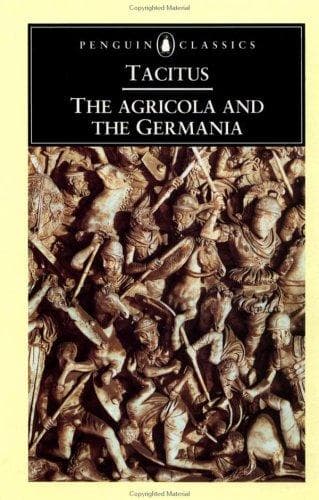
Agricola, Gnaeus Julius, 40-93; Germanic peoples -- Early works to 1800; Statesmen -- Rome -- Biography -- Early works to 1800
_Veteranorum colonia_. Camolodunum. Ann. 12, 32. Now Colchester. Dr.--_Et
reges. Kings also_, i.e. besides other means.--_Ut vetere_, etc. So in
the MSS. and earliest editions. Rhenanus transferred _ut_ to the place
before _haberet_ which it occupies in the common editions. But no change
is necessary. Render: _that in accordance with their established custom,
the Roman people might have kings also as the instruments of reducing_
(the Britons) _to slavery_.
_Didius Gallus_. Cf. Ann. 12, 40: arcere hostem satis habebat.--_Parta a
prioribus. The acquisitions (conquests) of his predecessors_.
_Aucti officii. Of enlarging the boundaries of his government. Officium_
is used in a like sense, Caes. B.C. 3, 5: Toti officio maritimo
praepositus, etc. So Wr.; Or. and Död. understand by it _going beyond_
the mere performance of his _duty_. It was his duty to protect his
province: he enlarged it.--_Quaereretur_. Subj. in a relative clause
denoting a purpose. H. 500; Z. 567.
_Veranius_. Ann. 14, 29.--_Paullinus_. Ann. 14, 29-30.
_Monam insulam_. Now Anglesey. But the _Mona_ of _Caesar_ is the Isle of
Man, called by Pliny _Monapia_. The Mona of T. was the chief seat of the
Druids, hence _ministrantem vires rebellibus_, for the Druids animated
and led on the Briton troops to battle. T. has given (Ann. 14, 30) a very
graphic sketch of the mixed multitude of armed men, women like furies,
and priests with hands uplifted in prayer, that met Paullinus on his
landing, and, for a time, well nigh paralyzed his soldiers with dismay.
In the same connexion, he speaks also of the human sacrifices and other
barbarous rites, which were practised by our Briton Fathers in honor of
their gods.
XV. _Interpretando. By putting their own_, i.e. _the worst construction
upon them_.
_Ex facili_==facile. A frequent form of expression in T., ad Graecorum
consuetudinem. Dr. See R. Exc. 24.
_Singulos--binos_. Distributives==_one for each tribe--two for each
tribe_.
_Aeque--aeque_. Like Greek correlatives; alike fatal to their subjects
in _either case_. So [Greek: homoios men] and [Greek: homoios de], Xen.
Mem. 1, 6, 13; Plat. Symp. 181. C.
_Alterius manus centuriones, alterius servos_. This is the reading of the
latest editions (Dr. Wr. Or. and R.), and the best MSS., though the MSS.
differ somewhat: _Centurions, the hands_ (instruments) _of the one, and
servants_, the hands _of the other, added insult to injury_. For the use
of _manus_ in the above sense, reference is made to Cic. in Ver. 2, 10,
27: Comites illi tui delecti _manus_ erant tuae. So the _centurions_ of
the _legate_ and the _servants_ of the _procurator_ are said by our
author to have robbed the Briton King Prasutagus of his kingdom and his
palace, Ann. 14, 31, which is the best commentary on the passage before
us.
Public-domain text, read in full here on John Shaqi.
Reviews
Reviews
No reviews yet
Be the first to share your thoughts on this work.
Elsewhere in the archive
Join the Discussion
Join the discussion
Sign in to leave a comment or review.
Sign InorCreate an account