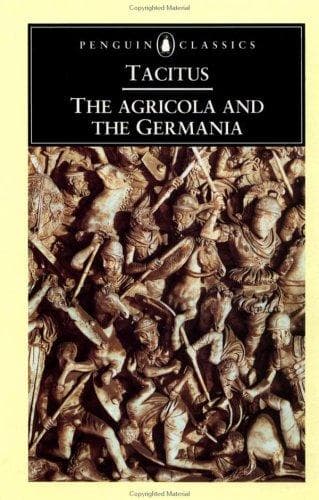
Agricola, Gnaeus Julius, 40-93; Germanic peoples -- Early works to 1800; Statesmen -- Rome -- Biography -- Early works to 1800
_Potuere_. Observe the ind., where we use the potential. It is especially
frequent with _possum, debeo_, &c. Z. 518 and 519.
_Nonne_ implies an affirmative answer. Z. 352, and H. 346, II. 1. 2.
_In poenitentiam_, al. in praesentiam. The general idea is essentially
the same with either reading. _Non in praesentiam==not to obtain our
freedom, for the present merely. Non in poenitentiam==not about to
obtain our freedom merely to regret it_, i.e. in such a manner as the
Brigantes, who forthwith lost it by their _socordia_.
XXXII. _Nisi si_==nisi forte, cf. note, G. 2: nisi si patria.
_Pudet dictu_. The supine after _pudet_ is found only here. Quintilian
however has _pudendum dictu_. Cf. Or. in loc.; and Z. 441. 443.
_Commendent_, etc. _Although they give up their blood to_ (i.e. _shed it
in support of_) _a foreign tyrant_.--_Tamen_ is antithetic to _licet_:
_although_ they give, _yet longer enemies, than slaves_ (of Rome).
_Metus--est_. _It is fear and terror_ (sc. that keep them in subjection),
_weak bonds of affection_.
_Removeris--desierint_. Fut. perf. Cf. note, G. 23: _indulseris_.
_Nulla--aut alia_. Some of the Roman soldiers had lost all attachment to
country and could not be said to have any country; others had one, but it
was not Britain, it was far away.
_Ne terreat_. The third person of the imperative is for the most part
avoided in ordinary language; and the pres. subj. is used in its stead.
Z. 529, Note.
_Nostras manus_, i.e. those ready to join us and aid our arms, viz. (as
he goes on to say), the Gauls and Germans, as well as the Britons now in
the Roman ranks.--_Tamquam_==_just as_ (_tam-quam_). Död. renders, _just
as certainly as_.
_Vacua.--Destitute of soldiers.--Senum_, sc. veterani et emeriti. Cf.
note, 15. _Aegra==disaffected_. Cf. H. 2, 86.
_Hic dux_, etc. _Here a general, here an army_ (sc. the Roman, awaits
you); _there tributes, mines_, &c. (and you must conquer the former or
endure the latter--these are your only alternatives).
_In hoc campo est_. _Depends on this battle field_.--T. has laid out all
his strength on this speech. It can hardly be matched for martial force
and sententious brevity. It breathes, as it should in the mouth of a
Briton, an indomitable spirit of liberty, and reminds us, in many
features, of the concentrated and fiery eloquence, which has so often
roused our American Indians to defend their altars and revenge their
wrongs.
XXXIII. _Ut barbaris moris_. Al. et barbari moris. But compare 39: ut
Domitiano moris erat; His. 1, 15: ut moris est. Supply _est_ here: _as is
the custom of_ (lit. _to_) _barbarians_. Z. 448, & H. 402, I.
_Agmina_, sc. conspiciebantur.--_Procursu_ is the means by which the
gleam of armor was brought into view.
_Acies_, sc. Britannorum. The _Roman_ army was still within the camp, cf.
_munimentis coercitum_, below.
Public-domain text, read in full here on John Shaqi.
Reviews
Reviews
No reviews yet
Be the first to share your thoughts on this work.
Elsewhere in the archive
Join the Discussion
Join the discussion
Sign in to leave a comment or review.
Sign InorCreate an account