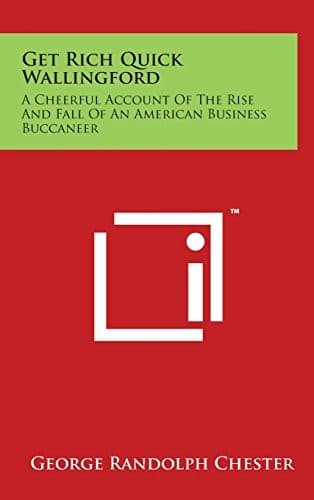
Get-Rich-Quick Wallingford: A Cheerful Account of the Rise and Fall of an American Business BuccaneerChester, George Randolph
General
Get-Rich-Quick Wallingford: A Cheerful Account of the Rise and Fall of an American Business Buccaneer
Chester, George Randolph
Businessmen -- Fiction; New York (N.Y.) -- Fiction; Swindlers and swindling -- Fiction
In South Dakota, on the same day, two farmers who had brought in their
wheat drove home with it, refusing the price offered with scorn. In
Pennsylvania not one-tenth of the grain was delivered as on the same
date a year before, and the crop was much larger. In Ohio, in Indiana,
in Illinois, in Iowa, in Nebraska, all through the wheat belt began
these significant incidents, and to brokers in Chicago and New York were
wired startling reports from a hundred centers: farmers were delivering
no wheat and were holding out for a dollar and a half!
"You can scare the entire Board of Trade black in the face with a
Hallowe'en pumpkin," Wallingford had declared to Blackie Daw. "Say
'Boo!' and they drop dead. Step on a parlor match and every trader jumps
straight up into the gallery. Four snowflakes make a blizzard, and a
frost on State Street kills all the crops in Texas."
Results seemed to justify his summing up. On that day wheat jumped ten
cents within the last hour before closing, and ten thousand small
speculators who had been bearing the market, since they could see no
good reason for the already high price, were wiped out before they had a
chance to protect their margins. On the following day a special edition
of the _Commercial Farmer_ was issued. It exulted, it gloated, it fairly
shrieked over the triumph that had already been accomplished by the
Farmers' Commercial Association. The first minute that it had shown its
teeth it had made for the farmers of the United States ten cents a
bushel on four hundred million bushels of wheat! It had made for them in
one hour forty million dollars net profit, and this was but the
beginning. The farmers themselves, by standing together, had already
raised the price of wheat to a dollar-fifteen, and dollar-and-a-half
wheat was but a matter of a few days. On the boards of trade it would go
even higher. There would be no stopping it. It would soar to a dollar
and a half, to a dollar-seventy-five, to two dollars! Speculation was a
thing ordinarily to be discouraged, yet under these circumstances the
farmers themselves should reap the wealth that was now ripe. They should
take out of "Wall Street" and La Salle Street their share of the money
that these iniquitous centers of financial jugglery had taken from the
agricultural interests of the country for these many years. They
themselves knew now, by the events of one day, that the Farmers'
Commercial Association was strong enough to accomplish what it had meant
to accomplish, and now was the time to get into the market. It should be
not only the pleasure and profit of every farmer, but the duty of every
farmer, to hit the gamblers a fatal blow by investing every loose
dollar, on safe and conservative margins, in this certain advance of
wheat. On the last page of this issue of the _Commercial Farmer_
appeared for the first time the advertisement of Fox & Fleecer, and
copies went to a million wheat growers.
Public-domain text, read in full here on John Shaqi.
Reviews
Reviews
No reviews yet
Be the first to share your thoughts on this work.
Elsewhere in the archive
Join the Discussion
Join the discussion
Sign in to leave a comment or review.
Sign InorCreate an account