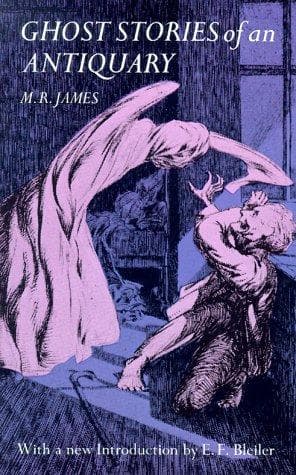
Ghost Stories of an AntiquaryJames, M. R. (Montague Rhodes)
General
Ghost Stories of an Antiquary
James, M. R. (Montague Rhodes)
Ghost stories, English; Horror tales, English; Short stories, English
In the afternoon he had done with these, and after returning the boxes
in which they were kept to their places on the shelf, he proceeded,
very naturally, to take down some of the volumes nearest to them, in
order to determine which of them had best be his principal subject of
investigation next day. The shelf he had hit upon was occupied mostly
by a collection of account-books in the writing of the first Count
Magnus. But one among them was not an account-book, but a book of
alchemical and other tracts in another sixteenth-century hand. Not
being very familiar with alchemical literature, Mr Wraxall spends much
space which he might have spared in setting out the names and
beginnings of the various treatises: The book of the Phœnix, book of
the Thirty Words, book of the Toad, book of Miriam, Turba
philosophorum, and so forth; and then he announces with a good deal of
circumstance his delight at finding, on a leaf originally left blank
near the middle of the book, some writing of Count Magnus himself
headed “Liber nigræ peregrinationis”. It is true that only a few lines
were written, but there was quite enough to show that the landlord had
that morning been referring to a belief at least as old as the time of
Count Magnus, and probably shared by him. This is the English of what
was written:
“If any man desires to obtain a long life, if he would obtain a
faithful messenger and see the blood of his enemies, it is necessary
that he should first go into the city of Chorazin, and there salute the
prince….” Here there was an erasure of one word, not very thoroughly
done, so that Mr Wraxall felt pretty sure that he was right in reading
it as _aëris_ (“of the air”). But there was no more of the text copied,
only a line in Latin: _Quære reliqua hujus materiei inter secretiora_.
(See the rest of this matter among the more private things.)
It could not be denied that this threw a rather lurid light upon the
tastes and beliefs of the Count; but to Mr Wraxall, separated from him
by nearly three centuries, the thought that he might have added to his
general forcefulness alchemy, and to alchemy something like magic, only
made him a more picturesque figure; and when, after a rather prolonged
contemplation of his picture in the hall, Mr Wraxall set out on his
homeward way, his mind was full of the thought of Count Magnus. He had
no eyes for his surroundings, no perception of the evening scents of
the woods or the evening light on the lake; and when all of a sudden he
pulled up short, he was astonished to find himself already at the gate
of the churchyard, and within a few minutes of his dinner. His eyes
fell on the mausoleum.
“Ah,” he said, “Count Magnus, there you are. I should dearly like to
see you.”
Public-domain text, read in full here on John Shaqi.
Reviews
Reviews
No reviews yet
Be the first to share your thoughts on this work.
Elsewhere in the archive
Join the Discussion
Join the discussion
Sign in to leave a comment or review.
Sign InorCreate an account