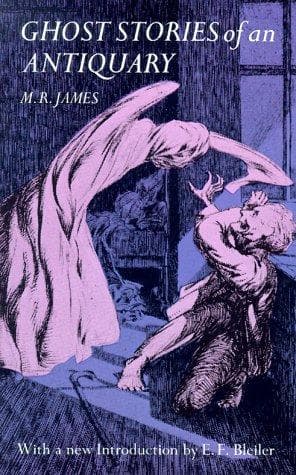
Ghost Stories of an AntiquaryJames, M. R. (Montague Rhodes)
General
Ghost Stories of an Antiquary
James, M. R. (Montague Rhodes)
Ghost stories, English; Horror tales, English; Short stories, English
“Like many solitary men,” he writes, “I have a habit of talking to
myself aloud; and, unlike some of the Greek and Latin particles, I do
not expect an answer. Certainly, and perhaps fortunately in this case,
there was neither voice nor any that regarded: only the woman who, I
suppose, was cleaning up the church, dropped some metallic object on
the floor, whose clang startled me. Count Magnus, I think, sleeps sound
enough.”
That same evening the landlord of the inn, who had heard Mr Wraxall say
that he wished to see the clerk or deacon (as he would be called in
Sweden) of the parish, introduced him to that official in the inn
parlour. A visit to the De la Gardie tomb-house was soon arranged for
the next day, and a little general conversation ensued.
Mr Wraxall, remembering that one function of Scandinavian deacons is to
teach candidates for Confirmation, thought he would refresh his own
memory on a Biblical point.
“Can you tell me,” he said, “anything about Chorazin?”
The deacon seemed startled, but readily reminded him how that village
had once been denounced.
“To be sure,” said Mr Wraxall; “it is, I suppose, quite a ruin now?”
“So I expect,” replied the deacon. “I have heard some of our old
priests say that Antichrist is to be born there; and there are tales—”
“Ah! what tales are those?” Mr Wraxall put in.
“Tales, I was going to say, which I have forgotten,” said the deacon;
and soon after that he said good night.
The landlord was now alone, and at Mr Wraxall’s mercy; and that
inquirer was not inclined to spare him.
“Herr Nielsen,” he said, “I have found out something about the Black
Pilgrimage. You may as well tell me what you know. What did the Count
bring back with him?”
Swedes are habitually slow, perhaps, in answering, or perhaps the
landlord was an exception. I am not sure; but Mr Wraxall notes that the
landlord spent at least one minute in looking at him before he said
anything at all. Then he came close up to his guest, and with a good
deal of effort he spoke:
“Mr Wraxall, I can tell you this one little tale, and no more—not any
more. You must not ask anything when I have done. In my grandfather’s
time—that is, ninety-two years ago—there were two men who said: ‘The
Count is dead; we do not care for him. We will go tonight and have a
free hunt in his wood’—the long wood on the hill that you have seen
behind Råbäck. Well, those that heard them say this, they said: ‘No, do
not go; we are sure you will meet with persons walking who should not
be walking. They should be resting, not walking.’ These men laughed.
There were no forestmen to keep the wood, because no one wished to live
there. The family were not here at the house. These men could do what
they wished.
“Very well, they go to the wood that night. My grandfather was sitting
here in this room. It was the summer, and a light night. With the
window open, he could see out to the wood, and hear.
Public-domain text, read in full here on John Shaqi.
Reviews
Reviews
No reviews yet
Be the first to share your thoughts on this work.
Elsewhere in the archive
Join the Discussion
Join the discussion
Sign in to leave a comment or review.
Sign InorCreate an account