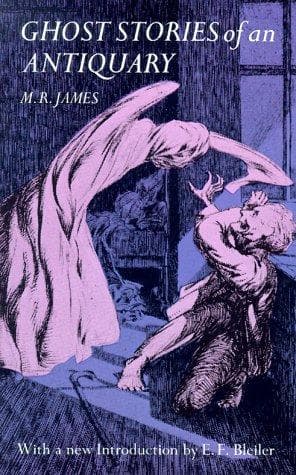
Ghost Stories of an AntiquaryJames, M. R. (Montague Rhodes)
General
Ghost Stories of an Antiquary
James, M. R. (Montague Rhodes)
Ghost stories, English; Horror tales, English; Short stories, English
“Oh, I don’t know! There’s certain to be somebody I know in the place;
but, of course, if you don’t want me, speak the word, Parkins; I shan’t
be offended. Truth, as you always tell us, is never offensive.”
Parkins was, indeed, scrupulously polite and strictly truthful. It is
to be feared that Mr Rogers sometimes practised upon his knowledge of
these characteristics. In Parkins’s breast there was a conflict now
raging, which for a moment or two did not allow him to answer. That
interval being over, he said:
“Well, if you want the exact truth, Rogers, I was considering whether
the room I speak of would really be large enough to accommodate us both
comfortably; and also whether (mind, I shouldn’t have said this if you
hadn’t pressed me) you would not constitute something in the nature of
a hindrance to my work.”
Rogers laughed loudly.
“Well done, Parkins!” he said. “It’s all right. I promise not to
interrupt your work; don’t you disturb yourself about that. No, I won’t
come if you don’t want me; but I thought I should do so nicely to keep
the ghosts off.” Here he might have been seen to wink and to nudge his
next neighbour. Parkins might also have been seen to become pink. “I
beg pardon, Parkins,” Rogers continued; “I oughtn’t to have said that.
I forgot you didn’t like levity on these topics.”
“Well,” Parkins said, “as you have mentioned the matter, I freely own
that I do _not_ like careless talk about what you call ghosts. A man in
my position,” he went on, raising his voice a little, “cannot, I find,
be too careful about appearing to sanction the current beliefs on such
subjects. As you know, Rogers, or as you ought to know; for I think I
have never concealed my views—”
“No, you certainly have not, old man,” put in Rogers _sotto voce._
“—I hold that any semblance, any appearance of concession to the view
that such things might exist is equivalent to a renunciation of all
that I hold most sacred. But I’m afraid I have not succeeded in
securing your attention.”
“Your _undivided_ attention, was what Dr Blimber actually _said_,”[4]
Rogers interrupted, with every appearance of an earnest desire for
accuracy. “But I beg your pardon, Parkins: I’m stopping you.”
[4] Mr Rogers was wrong, _vide Dombey and Son_, chapter xii.
“No, not at all,” said Parkins. “I don’t remember Blimber; perhaps he
was before my time. But I needn’t go on. I’m sure you know what I
mean.”
“Yes, yes,” said Rogers, rather hastily—“just so. We’ll go into it
fully at Burnstow, or somewhere.”
In repeating the above dialogue I have tried to give the impression
which it made on me, that Parkins was something of an old woman—rather
henlike, perhaps, in his little ways; totally destitute, alas! of the
sense of humour, but at the same time dauntless and sincere in his
convictions, and a man deserving of the greatest respect. Whether or
not the reader has gathered so much, that was the character which
Parkins had.
Public-domain text, read in full here on John Shaqi.
Reviews
Reviews
No reviews yet
Be the first to share your thoughts on this work.
Elsewhere in the archive
Join the Discussion
Join the discussion
Sign in to leave a comment or review.
Sign InorCreate an account