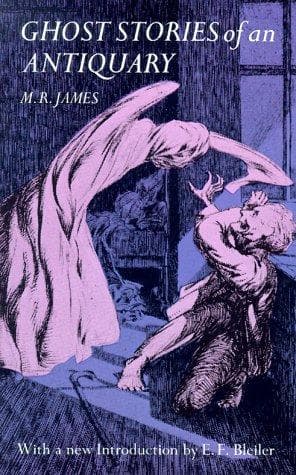
Ghost Stories of an AntiquaryJames, M. R. (Montague Rhodes)
General
Ghost Stories of an Antiquary
James, M. R. (Montague Rhodes)
Ghost stories, English; Horror tales, English; Short stories, English
This he accomplished, I may say, in the most literal sense, for in
picking his way from the links to the shingle beach his foot caught,
partly in a gorse-root and partly in a biggish stone, and over he went.
When he got up and surveyed his surroundings, he found himself in a
patch of somewhat broken ground covered with small depressions and
mounds. These latter, when he came to examine them, proved to be simply
masses of flints embedded in mortar and grown over with turf. He must,
he quite rightly concluded, be on the site of the preceptory he had
promised to look at. It seemed not unlikely to reward the spade of the
explorer; enough of the foundations was probably left at no great depth
to throw a good deal of light on the general plan. He remembered
vaguely that the Templars, to whom this site had belonged, were in the
habit of building round churches, and he thought a particular series of
the humps or mounds near him did appear to be arranged in something of
a circular form. Few people can resist the temptation to try a little
amateur research in a department quite outside their own, if only for
the satisfaction of showing how successful they would have been had
they only taken it up seriously. Our Professor, however, if he felt
something of this mean desire, was also truly anxious to oblige Mr
Disney. So he paced with care the circular area he had noticed, and
wrote down its rough dimensions in his pocket-book. Then he proceeded
to examine an oblong eminence which lay east of the centre of the
circle, and seemed to his thinking likely to be the base of a platform
or altar. At one end of it, the northern, a patch of the turf was
gone—removed by some boy or other creature _feraæ naturæ_. It might, he
thought, be as well to probe the soil here for evidences of masonry,
and he took out his knife and began scraping away the earth. And now
followed another little discovery: a portion of soil fell inward as he
scraped, and disclosed a small cavity. He lighted one match after
another to help him to see of what nature the hole was, but the wind
was too strong for them all. By tapping and scratching the sides with
his knife, however, he was able to make out that it must be an
artificial hole in masonry. It was rectangular, and the sides, top, and
bottom, if not actually plastered, were smooth and regular. Of course
it was empty. No! As he withdrew the knife he heard a metallic clink,
and when he introduced his hand it met with a cylindrical object lying
on the floor of the hole. Naturally enough, he picked it up, and when
he brought it into the light, now fast fading, he could see that it,
too, was of man’s making—a metal tube about four inches long, and
evidently of some considerable age.
Public-domain text, read in full here on John Shaqi.
Reviews
Reviews
No reviews yet
Be the first to share your thoughts on this work.
Elsewhere in the archive
Join the Discussion
Join the discussion
Sign in to leave a comment or review.
Sign InorCreate an account