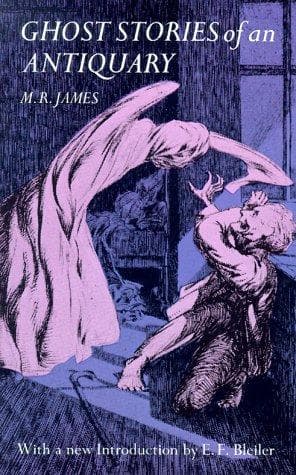
Ghost Stories of an AntiquaryJames, M. R. (Montague Rhodes)
General
Ghost Stories of an Antiquary
James, M. R. (Montague Rhodes)
Ghost stories, English; Horror tales, English; Short stories, English
I can figure to myself something of the Professor’s bewilderment and
horror, for I have in a dream thirty years back seen the same thing
happen; but the reader will hardly, perhaps, imagine how dreadful it
was to him to see a figure suddenly sit up in what he had known was an
empty bed. He was out of his own bed in one bound, and made a dash
towards the window, where lay his only weapon, the stick with which he
had propped his screen. This was, as it turned out, the worst thing he
could have done, because the personage in the empty bed, with a sudden
smooth motion, slipped from the bed and took up a position, with
outspread arms, between the two beds, and in front of the door. Parkins
watched it in a horrid perplexity. Somehow, the idea of getting past it
and escaping through the door was intolerable to him; he could not have
borne—he didn’t know why—to touch it; and as for its touching him, he
would sooner dash himself through the window than have that happen. It
stood for the moment in a band of dark shadow, and he had not seen what
its face was like. Now it began to move, in a stooping posture, and all
at once the spectator realized, with some horror and some relief, that
it must be blind, for it seemed to feel about it with its muffled arms
in a groping and random fashion. Turning half away from him, it became
suddenly conscious of the bed he had just left, and darted towards it,
and bent and felt over the pillows in a way which made Parkins shudder
as he had never in his life thought it possible. In a very few moments
it seemed to know that the bed was empty, and then, moving forward into
the area of light and facing the window, it showed for the first time
what manner of thing it was.
Parkins, who very much dislikes being questioned about it, did once
describe something of it in my hearing, and I gathered that what he
chiefly remembers about it is a horrible, an intensely horrible, face
_of crumpled linen._ What expression he read upon it he could not or
would not tell, but that the fear of it went nigh to maddening him is
certain.
But he was not at leisure to watch it for long. With formidable
quickness it moved into the middle of the room, and, as it groped and
waved, one corner of its draperies swept across Parkins’s face. He
could not, though he knew how perilous a sound was—he could not keep
back a cry of disgust, and this gave the searcher an instant clue. It
leapt towards him upon the instant, and the next moment he was half-way
through the window backwards, uttering cry upon cry at the utmost pitch
of his voice, and the linen face was thrust close into his own. At
this, almost the last possible second, deliverance came, as you will
have guessed: the Colonel burst the door open, and was just in time to
see the dreadful group at the window. When he reached the figures only
one was left. Parkins sank forward into the room in a faint, and before
him on the floor lay a tumbled heap of bed-clothes.
Public-domain text, read in full here on John Shaqi.
Reviews
Reviews
No reviews yet
Be the first to share your thoughts on this work.
Elsewhere in the archive
Join the Discussion
Join the discussion
Sign in to leave a comment or review.
Sign InorCreate an account