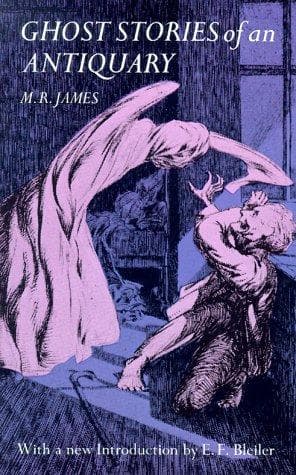
Ghost Stories of an AntiquaryJames, M. R. (Montague Rhodes)
General
Ghost Stories of an Antiquary
James, M. R. (Montague Rhodes)
Ghost stories, English; Horror tales, English; Short stories, English
The passage with which I began my story had set the antiquary on the
track of another identification. In a private chapel—no matter where—he
had seen three large figures, each occupying a whole light in a window,
and evidently the work of one artist. Their style made it plain that
that artist had been a German of the sixteenth century; but hitherto
the more exact localizing of them had been a puzzle. They
represented—will you be surprised to hear it?—JOB PATRIARCHA, JOHANNES
EVANGELISTA, ZACHARIAS PROPHETA, and each of them held a book or
scroll, inscribed with a sentence from his writings. These, as a matter
of course, the antiquary had noted, and had been struck by the curious
way in which they differed from any text of the Vulgate that he had
been able to examine. Thus the scroll in Job’s hand was inscribed:
_Auro est locus in quo absconditur_ (for _conflatur_);[6] on the book
of John was: _Habent in vestimentis suis scripturam quam nemo novit_[7]
(for in _vestimento scriptum_, the following words being taken from
another verse); and Zacharias had: _Super lapidem unum septem oculi
sunt_[8] (which alone of the three presents an unaltered text).
[6] There is a place for gold where it is hidden.
[7] They have on their raiment a writing which no man knoweth.
[8] Upon one stone are seven eyes.
A sad perplexity it had been to our investigator to think why these
three personages should have been placed together in one window. There
was no bond of connexion between them, either historic, symbolic, or
doctrinal, and he could only suppose that they must have formed part of
a very large series of Prophets and Apostles, which might have filled,
say, all the clerestory windows of some capacious church. But the
passage from the _Sertum_ had altered the situation by showing that the
names of the actual personages represented in the glass now in Lord
D——’s chapel had been constantly on the lips of Abbot Thomas von
Eschenhausen of Steinfeld, and that this Abbot had put up a painted
window, probably about the year 1520, in the south aisle of his abbey
church. It was no very wild conjecture that the three figures might
have formed part of Abbot Thomas’s offering; it was one which,
moreover, could probably be confirmed or set aside by another careful
examination of the glass. And, as Mr. Somerton was a man of leisure, he
set out on pilgrimage to the private chapel with very little delay. His
conjecture was confirmed to the full. Not only did the style and
technique of the glass suit perfectly with the date and place required,
but in another window of the chapel he found some glass, known to have
been bought along with the figures, which contained the arms of Abbot
Thomas von Eschenhausen.
Public-domain text, read in full here on John Shaqi.
Reviews
Reviews
No reviews yet
Be the first to share your thoughts on this work.
Elsewhere in the archive
Join the Discussion
Join the discussion
Sign in to leave a comment or review.
Sign InorCreate an account